
 With a personality like Jim Morrison fronting the band, there's little wonder that the intensely brilliant musicianship of Ray Manzarek, John Densmore and Robby Krieger was often eclipsed by his looming figure. Once Morrison was dead, in July 1971, there must have seemed little point in the trio continuing. Luckily, however, they did continue as a band, recording Other Voices and Full Circle.
When I first read about these albums in Danny Sugerman and Jerry Hopkins' biography of Jim Morrison No One Here Gets Out Alive, my first thought was, "Damn, how depressing must that have been, going into the studio with Jim Morrison dead and buried in France?" But hearing both albums, now, my verdict is that I'm thrilled the remaining Doors continued to record. The demise of Morrison (rumors of him having faked his death aside) following the release of the astonishing L.A. Woman LP was the height of anti-climax -- or, maybe just too pat an ending to this real-life story.
By December 1971, The Doors as a trio released Other Voices:
1. "In the Eye of the Sun" – 4:48
2. "Variety Is the Spice of Life" – 2:50
3. "Ships With Sails" – 7:38
4. "Tightrope Ride" – 4:15
5. "Down on the Farm" – 4:15
6. "I'm Horny, I'm Stoned" – 3:55
7. "Wandering Musician" – 6:25
8. "Hang on to Your Life" – 5:36
Without Jim Morrison at the lyric and vocal helm, it's fair for the passing music fan to wonder, "What's the point?" Well, the point is that The Doors, musically, had much life left in them after July 1971.
The first track of the album, "In the Eye of the Sun," is a rock/blues fusion with Ray Manzarek on vocals. Musically, most of the tracks are absolutely amazing in the breath of sonic landscape they cover. Think of the numerous changes of mood and tempo in the song "L.A. Woman," and multiply that by three or five.
The lyrics throughout the album tend toward the crackpot mystical. I didn't detect any outright attempts to imitate Morrison's style; maybe that pseudo-L.A. mysticisim was more a product of the times.
"Variety is the Spice of Life" is sung by Robby Krieger, and sadly, the song is as lame as its title. Regardless of how weak or strong the vocal performances are (and they never rise far beyond weak), Krieger's guitar work mesmerizes. The man seems wonderfully incapable of repeating himself.
"Ships with Sails," musically, is classic Doors. Robby Krieger's guitar is reminiscent of "Love Street," "Blue Monday" and "Indian Summer." There is a stand-up bass played alongside Manzarek's subdued "Riders on the Storm" keyboards, which makes for a wonderfully atmospheric piece.
"Tighrope Ride" is a great little upbeat rock 'n' roll song that might really have turned into something with Jim Morrison at the microphone and handling the lyrics. Still, very much worth hearing. Manzarek, whose vocals are pretty lousy throughout the album, comes as close to singing well on this track.
"Down on the Farm" is another wonderful moody track that adds xylophone to the sonic mix. This is one of the songs that morphs and transitions through an improbable series of sound textures -- from hypnotic, drugged-out L.A. nodding-off in the sunset into jughead country hick twanging, from which the song draws its title.
If you've ever tried downloading rare Doors tracks you might have run into "I'm Horny, I'm Stoned." It's an upbeat sort of throwaway song sung by Robby Krieger. On its own, hearing it for the first time in 2001, I thought it an interesting novelty track that didn't hold anything beyond the first listening. But on this album it's a bit more of a kick.
"Wandering Musician" begins with slow, meditative keyboards that build into something rock steady and quite beautiful. As the track unfolds, Ray Manzarek's genius for invention is on full display. Nowhere on the album do The Doors attempt to recreate the past. These tracks are fresh compositions. Had the tracks been allowed to flourish as instrumentals, it would have been interesting what directions they might have taken not being hemmed in by lyrics.
"Hang on to Your Life" is upbeat, with a livelier performance from John Densmore than anywhere else on the album. Robby Krieger, once more, is in flying form with one fresh, signature Doors lick after another. This is a jazzier song in which each musician has truly shown up to play. Their inventiveness as a trio is painfully evident -- painfully, because the tragedy of The Doors' story is that neither this, nor their next album got much notice before utterly fading away.
There are no odes to Jim Morrison on the album. His absence is a gaping blackhole -- no sense drawing even more attention to that fact. For as blinding and impressive as the musicianship is here, The Doors were really not The Doors without Morrison. Manzarek and Krieger make their attempts on vocals, but I think this album might have been much better had it been conceived as straightahead instrumental. Jim Morrison was an exceptional rock 'n' roll singer and a first-rate writer of rock 'n' roll song lyrics. This album is all about the remaining Doors and the ideas they might have brought into the studio had Morrison arrived from France after the summer of '71, alive, refreshed and ready to follow-up L.A. Woman.
If you're a Jim Morrison fan, you probably won't find anything worthwhile in Other Voices because the album truly lives up to its title. For fans of The Doors' music, this will prove to be a surreal, interesting, and at times, weirdly satisfying journey through the veil of "what might have been." The imagination and talent of Jim Morrison is sorely missing, but to their credit the remaining Doors made no attempt to replace him -- either with a new vocalist or by their own efforts to round things out by writing lyrics of their own and doing vocals.
Music doesn't get much more haunting and interesting than this.


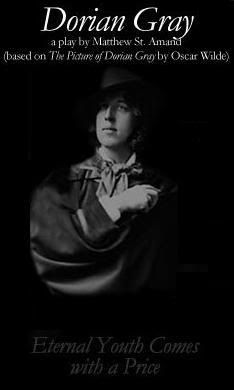 So, the bear-trap of bad luck snapped shut on my play Dorian Gray. The day before it was to be performed at the Capitol Theatre in downtown Windsor, Ontario, the theatre closed; gone bust. The official nuts-and-bolts of the story is more complex than this, but the net effect is the same.


 It was a mean and dissolute time for me. I was in a depression that would last years and took me months to even realize what psychological succubus enveloped me. To awkwardly quote from The Pogues song "The Sickbed of Cuchulainn" -- "There's a glass of punch below your feet and an angel at your head / There's devils on each side of you..." There were self-made devils all around of me at this time, certainly, but the angel at my head was my good friend, Speed. Born of Bavarian parentage, psychologically assembled by James Bond novels, James Brown music and the best of 1970s television viewing, he was a man for all seasons. You know that scene in the John Belushi bio pic, Wired when Bob Woodward is at Belushi's deathbed and Belushi implores him, "Breathe for me, Woodward!"? Speed breathed for me on countless occasions.
 Pryvett, the Alchemist of the Internet. His latest Web find:
 About a week ago I heard a story on NPR about the soundtrack to the 1965 A Charlie Brown Christmas. I'm a longtime fan of the Charlie Brown specials -- lusting after all those Dolly Madison dessert commercials. One thing I never gave much thought to was the music of A Charlie Brown Christmas, which was composed and played by underrated jazz genius, Vince Guaraldi. The fact, alone, that the man composed "Linus and Lucy," the Charlie Brown theme, places him right next to Mozart and Handel in my book.
  Say your parents enrolled you in a group when you were a small child, far too young to make your own decisions. Many people your age were signed up, too -- as though for little league baseball or midget hockey -- and whole groups of you went through the little rites that came when you were seven years of age, nine years of age, thirteen. Then one day when you were old enough to make your own decisions, you leared that the group in which your parents enrolled you was Hitler Youth.
  Ventured back into my favorite territory this weekend -- back into heavy movie-watching. Rented a really cool documentary about an all-American weirdo-Brian-Wilson-type-genius titled The Devil and Daniel Johnston.
  Then I checked out the much-talked-about The Death of Mr. Lazarescu. The NPR review I heard weeks ago about the film made it sound like a surreal journey into the moments enveloping a human being after death. In fact, I distinctly recall how the reviewer cautioned the audience not to be put off by the fact that the main characters dies minutes into the film. Well, I must have crossed that review with the wrong film. The Death of Mr. Lazarescu is a slow-moving, dull, dreary story about an old man with a sore stomach and a sore head and how he encouners unpleasant doctors when he goes to the hospital. There is no surreal, philosophical look at death and dying. This is merely a dull travelogue of Romanian hospitals as Mr. Lazarescu is shuttled from healing house to healing house. An hour and twenty minutes into this drag, I shut the film off.
 The film-watching weekend, though, was completely salvaged when I viewed the entire four-film Ju On saga: Ju On: The Grudge, Ju On: The Grudge 2, Ju On: The Curse, Ju On: The Curse 2. The opening of each film informs the viewer: "Ju-on: The curse of one who dies in the grip of powerful rage. It gathers and takes effect in the places that person was alive. Those who encounter it die, and a new curse is born."
 I have never been handy with a hammer or any other sort of tool -- other than a keyboard. When I was a kid, though, I did enjoy going into my father's cluttered, chaotic workshop and randomly hammering nails into wood. There was a day when I was about eight or nine years old when I nailed two pieces of wood together. They formed a cross like the one in church that had the bronze statue of the tortured Jesus hanging from it. This was way back in the days before I realized god couldn't pass the Turing Test.
 With Mel Gibson only recently in the news about his anti-semiticism and now Michael Richards on the cultural griddle for his rapid-fire use of the "n"-word, it's time that I confess my own life-long prejudice.
 He has a face made to be struck with a shovel. His teeth have been honed on the necks of babies. There are no eyes behind his eyeglasses. Stick your hand into his chest and you're likely to pull out an electric eel or a hunk of undigested gristle from the body of a puppy.
  I was witness to a ghoulish, reprehensible display this week that revealed to me -- painfully so -- why America takes the idea of going to war with another nation so lightly; takes it on eagerly; almost gleefully, like going into this year's Homecoming Game.
  British scientist Richard Dawkins made a two-part documentary titled The Root of All Evil? in which he looks at religion -- particularly fundamentalist religion -- as possibly being evil, or, more like a predatory virus corrupting and warping our world, rather than making it a better place.


 The other day I found an interesting article on the Guerrilla News Network titled
  My adventures with the Linux flavor Ubuntu continued this week. The tagline for this abomination is "linux for human beings." I love the self-deprecating lowercase "L" on "linux" at the beginning of that. It says to me, "Hey man, we don't take ourselves seriously!" And they surely don't.

