
 Even before the biography No One Here Gets Out Alive was published, I was a fan of Jim Morrison and the music of The Doors. I still recall a time when articles, books and photos of Jim Morrison were difficult for rock fans to come by. Long before the Internet. Recently, I came into possession of a 1969 film titled HWY: An American Pastoral starring Jim Morrison. It's a grainy, fascinating, disappointing, surprising look at Morrison and his environment. The film is not a documentary, but an "experimental" work directed by Paul Ferrara and written by Paul Ferrara and Jim Morrison's ignoble friend, Babe Hill.
The film opens with Morrison, a drifter, swimming near a boulder-enclosed waterfall somewhere in the American desert. Oddly, as he steps out of the water, the audience sees that he wears his black leather trousers as he swam. As he makes his way up the rocky incline to the rest of his clothes, the camera zooms onto a "ban the bomb" symbol carved into the slender trunk of a slanted tree nearby.
Near the 8-minute mark of the film (while the drifter stands by the road trying to hitch a ride), Jim Morrison offers narration, speaking about an incident that occurred when he was a child travelling a car with his parents and grandparents, and witnessed the aftermath of a truck accident that left a group of Native Americans injured and dead, sprawled across the highway. The incident is mentioned briefly in the Morrison Hotel track "Peace Frog," but is spoken of here in greater detail. Far from sounding like the droning of some peyote-saturated desert hippie, Morrison's recollection is poignant and compelling, particularly when he speculates about the soul or souls of those Native Americans leaping into his body.
The music accompanying Morrison's hitchhiking is moody electric guitar.
Coming up on the 14-minute mark, the camera shoots Morrison from the side of the highway with the road behind him. As cars zoom past, Morrison flicks his jacket in their wake like a matador. It's a cool image, except it's repeated about six times.
Just after the 16-minute mark, the audience sees the drifter climbing out of an abandoned crashed car that has clearly been sitting off to the side of the road for a long time -- it's half-buried in the sand. It's a very arresting image. I couldn't help wondering how a car would be left for so long by the side of the road. Or what had happened to its original occupants. Morrison climbs out of it, then tosses a huge rock onto it. Then he jumps on the hood, and onto the roof of the car, before leaping back onto the sand, and continusing his trek up the road.
Around the 17-minute mark a car pulls over to give Morrison's character a ride. The camera perspectives shifts from filming Morrison from about 100 yards away up the highway, to inside the car from the driver's seat. For whatever reason, there is no dialogue. Morrison's character says nothing when he comes to the passenger-side window. Neither does the driver have anything to say. Morrison jumps into the car, it shoots back onto the highway, and the music shifts into folk-acoustic mode with a singer I can't identify singing. It quickly wears out its welcome.
At the 19-minute mark, the audience glimpses the drifter in the driver's seat of the car. The storyline of the movie is that the drifter murdered the driver because the driver was giving him unspecified "trouble" or "hassle." This evokes the line from the 1971 Door's album L.A. Woman in the song "Riders on the Storm": There's a killer on the road...
After the 20-minute mark, the audience finds the drifter in a roadside store that sells adult magazines, booze, and paperback novels. Morrison's character twirls the paperback book rack around and around for the camera. It's ultimately a time-waster of a scene, but it's interesting to catch a glimpse of the desert roadside from 1969. It would have been cool if the camera had caught more than a fleeting glimpse at the book covers, so the audience could catch some titles and names of authors.
Following the 22-minute mark the audience finds the drifter standing at the scene of some sort of accident. There is a dog lying injured on the highway (having been presumably hit by a car? If that was actually the case, the dog would not only be dead, its body would not be intact) howling in pain. If someone else was the focus of this accident, the audience never knows, but the drifter stands around observing the scene.
Just before the 24-minute mark the audience finds the drifter speeding down the highway drinking from an aluminum can. Presumably a beer. Which evokes the lyric from Morrison Hotel's "Roadhouse Blues": Keep your eyes on the road, your hands upon the wheel... and I woke up this morning and I got myself a beer... The drifter downs his beer and tosses the can out the open window. Then he lets out a scream.
Around the 26-minute mark the drifter is dancing with some Native American children by the side of the highway.
The 28-minute mark finds the drifter in darkness, standing before the headlights of the car he stole from the man he killed. The camera focuses on Morrison's legs as staggers around what appears to be a roadmap lying on the ground.
Soon after the 30-minute mark, the drifter pulls into a service station during the day to get gas. It's great watching Morrison smoking a cigarette only a few feet away from the gas pumps. No one around him seems bothered. None of the dialogue between the drifter and the service station attendant is audible. The drifter appears to pay for the gas using a credit card, possibly stolen from the car's dead owner.
Coming up to the 34-minute mark, the camera leads the audience through an exhaustive array of urban Los Angeles scenes. Less is always more; just a few of these shots would have been very effective, but these last a full six minutes. At which point the camera films a Los Angeles street (in something like stop-motion) from a stationary position in a building nearby.
Night falls and the lights of the bars and dives in the area come on.
At the 42-minute mark, backed by road sounds, the drifter is on a payphone with some unidentified person (whose voice we don't even hear), and the drifter mutters "I just got back into town... L.A.", evoking the line from the song "L.A. Woman": I just back into town about an hour ago...
The drifter says that he was in the desert for a while, out in the middle of it. Nothing comes of this conversation except for the drifter's understated confession about killing the owner of the car that brought him into town.
At the 45-minute mark, the drifter goes into a room in a cheap hotel, heads into the bathroom and takes a piss. Then leaves.
The only other noteworthy shot in this 51-minute film occurs out front of a seedy bar that has a mural of some actor looking over his shoulder on it. The drifter speaks to people hanging-out in front of this bar, but the dialogue in inaudible.
As a fan, I'm thrilled to have seen this film. I have no idea what sort of actor Jim Morrison might have made if he had been given more lines and more to do. Given the fact that he was a veteran hitchhiker in his real life, I wish the filmmaker would have drawn more on Morrison's experiences with weird or frightening drivers, to fill in the story. Also, the audience never knows why the drifter was in the desert, what caused him to leave, and why he goes to L.A., where he seems to be known. Answering these questions would have made for a longer film, and one that I think would have made greater use of Morrison's charisma, if nothing else.
Supplemental reading on Jim Morrison: the bizarro article by Thomas Lyttle Rumors, Myths and Urban Legends Surrounding the "Death" of Jim Morrison


 A longtime guilty pleasure of mine has been B science fiction movies from the 1970's and '80's: Soylent Green, Omega Man, Planet of the Apes, Westworld, The Incredible Hulk (pilot), Looker, and now what I consider the Holy Grail of such cinema:
 For more than a year I've been looking for an IT technical writing job. It's not my preferred mode of existence, but it is work I can do well and not lose my mind. As any jobseeker will tell you, it doesn't take long -- especially with online resume submissions -- before you're pumping out a few dozen applications per week (depending on the number of job openings, that is). In the past 13 months, I've had exactly one interview. And I have to wonder if having a link to this blog from my Web site, and my Web address on my resume, isn't costing me calls.
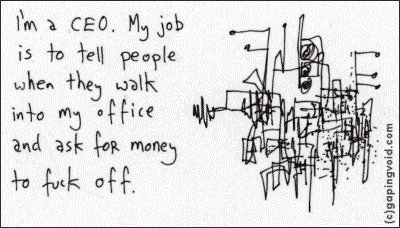 It's the disease/psychosis that just won't go away: corporate corruption.
  Heartwarming headline of the day:
  Have you ever wondered to which Christ these PreCambrian Christian Conservative cretins like George W. Bush, Dick Cheney, Donald Rumsfeld, Rick Santorum, et al adhere to, who hate poor people, hate the sick, love the rich, and love war? I have wondered about this. And the mystery has finally been solved by a find that rivals the discovery of the Dead Sea Scrolls in biblical significance:
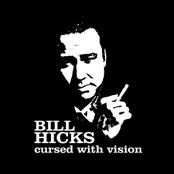 As a complete comedy aficionado, having been a hardcore fan of Lenny Bruce since I was twelve years old, buying Lenny Bruce and George Carlin cassettes and albums instead of those released by Corey Hart, Duran Duran, and all the other tripe my generation considered to be the coitus of the moment, it's a testament to the obscurity in which Bill Hicks languished that I never heard about him until a few years after he was dead. He was exactly the kind of comedian I would have sought out, but luckily network television blacked him out completely, and thus spared North American society a wave of panic that might have matched or surpassed that which Orson Welles achieved with his War of the Worlds radio spectacular in the 1930's.

 I'm not only seeking a
  I attended elementary school in the late '70's and early '80's. More than a few times discussion in our "environmental studies" classes -- the closest thing our cash and imagination strapped school board had to science class -- centered on how the future world (then, the Year 2000 was still the golden, seemingly unreachable science fiction dateline) would consist of solarium houses, jet packs rather than cumbersome cars, moving sidewalks, and no worries about the energy required to run any of this. Because it would all be solar powered, or by sunflower seeds or corn oil, or something.
 As a ruse to speed payment for some articles I wrote for a local magazine -- the only one worth writing for around here -- I sent the following note:
 For the past two months I have been a part of a very exciting and interesting group called The Windsor Film Club. We're a gaggle of film buffs, novice filmmakers, interested in writing and producing our own movie within the next three or four months.

 When William H. Macy's character is accused of lying in the David Mamet comedy, State and Main, he responds, "No, I just have a gift for fiction."
