Saturday, April 29, 2006

Poetic Justice Isn't Just for Poets Anymore

From CNN.com - Rehab, $30,000 to keep Limbaugh out of court: "Firebrand radio talk show host Rush Limbaugh was charged Friday with fraudulently concealing information to obtain prescription drugs, but prosecutors will drop the charge after 18 months if Limbaugh remains in treatment for drug addiction, his lawyer said."

And:

"The radio host turned himself in to the Palm Beach County sheriff's office on Friday and was released on bail before 5 p.m., a sheriff's spokesman said.

"Although Black urged reporters not to call it an arrest -- because Limbaugh turned himself in and was never handcuffed -- a sheriff's spokesman said technically he was under arrest during his booking." -- O, these hairsplitting cretins!

Drug addiction is a disease, not a crime. I agree with the late comedian Bill Hicks in his thinking that the American Drug Czar ought to be someone who was a former addict and knows not only about the ravages of that sickness, but has sought and obtained help, and knows firsthand what is involved with recovery.

That said, I find no small amount of poetic justice that the self-ordained and widely acknowledged mouthpiece of the American rightwing conservative movement, Rush Limbaugh, is an admitted, practicing drug addict. Of course he is.

I have listened to Rush Limbaugh here and there over the years and have never regarded him as anything other than a performer. Some performers remove their clothing before live audiences to earn their living, some performers fornicate on film, other performers play "death metal", and the truly reprehensible performers out there receive their ill-gotten gains by spreading bile and hatred, divisiveness, ignorance and bigotry.

The late comedian Bill Hicks once mused on stage that he believed Limbaugh to be one of those kinky people who enjoyed lying in a deep bathtub as others urinated on him. Of course he does.

Having listened to performer Limbaugh here and there over the years, I've been amused by the fact that only the soppiest, ass-kissiest callers are ever allowed through his switchboard and onto the air. Without fail, as these mentally impoverished, slow of foot and mouth, fearful, quivering sycophants deluge their master with squeaking praise, Limbaugh argues even with them! As they quote back to their succubus the particular bile that made their cretinous days, Limbaugh actually splits hairs over their incompetent quotes, and argues with them. Christ almighty, this guy cannot even get along with his most devoted supplicants!

And Limbaugh proves that the only way in which one can believe the things he believes is through the constant administration of drugs into his fetid physiology. The only way to be a true Republican party member is to literally be high on dope. Which, in true Republican hypocritical fashion, so many of these avowed rightwing hate-mongers would love to see stiff jail sentences, if not the death penalty, meted out to habitual drug addicts. Like Limbaugh.

All that separates Limbaugh from any other drug addict rotting in prison is geography -- rather than procuring his dope in low, bawdy dens of iniquity, Limbaugh purchased his scag in high-rent, well-appointed doctors' offices.

For all the years that Limbaugh has "doctor shopped" in order to feed his habit, this miserable miscreant ought to have been shopping for a goddamned soul. That's something his Centurion American Express card can't buy

Thursday, April 27, 2006

The Song That Signals Spring

Seems every spring there is one song that banishes winter, welcomes spring and carves a doorway unto summer.

In 1983, that song was "I'll Melt With You" by Modern English. The night I heard that song for the first time was the Friday I connected with my first girlfriend. It was late May and I saw the Modern English music video on the WRIF Video Cafe hosted by Steve Costand on Detroit's WXYZ. "I'll Melt With You" ignited a Pentacostal flame of romantic-horny-poetic-clamor in my bones and soul. I wasn't the same after seeing that music video, hearing that song.

Two years before that it was Led Zeppelin's "Fool in the Rain." I know that the Beach Boys are the offically recognized anthemeers of summer songs, but for me it's the intensely melodic, lyrically melancholic songs that wrench spring out of winters claws.

In 1998 it was Dave Matthews' "Crash." That was a season of spasmic unrequited love that seared me to depths I didn't know existed within me. "Crash" assuaged those pangs to a point at which I was at least able to breathe. I didn't get the girl that spring, but the strangled, inchoate longing I felt for fair Aisling was cut by "Crash" like laudanum -- transfiguring my psyche without outright poisoning me.

This year the song of spring is "Second Date" by Isaac Johnson. On the first listening the song immediately embodied the merry-melancholy sense of April, the universally acknowledged "cruelest month." I have been spending time recently with a special person, and this song immediately traced her outline within me, like a hand-shadow on the wall of my memory. Without question, "Second Date" is absolutely stunning work, evoking all of the awful, delicious uncertainty that makes early dates in a budding relationship so weighty, dreaded, and star-zapped.

I take the song to be an internal monologue the narrator conducts with himself in the midst of his second date; an internal monologue accelerated by anxiety, vividly painting the scene:
So I'm sittin at this table and I stare at her eyes that shine so bright
And I wonder what she's thinking now and if I'm doin alright

In the restaurant with no name I love to watch her smile
And I swear if it gets any brighter I just might go blind
Yeah, that's how it is. It's too early in the relationship for the narrator to be in love with this woman, but certainly not too early for him to be blown away by her looks, manner, laugh, and smile.

The part of the song that makes me think this is all interior monologue is that which serves as the chorus:
And I'll never understand why being everything is never enough for you
You don't even know why but you've made up your mind and I think I'm losin time
It's easy -- too easy -- to believe songs are always sung to someone else. I think this is the narrator prodding himself, losing his cool behind his calm exterior. Particularly the line "And I'll never understand why being everything is never enough for you." That sounds just like a guy silently beating the shit out of himself.

The music of this song, alone, would move me to the same heights of feeling. Isaac Johnson is clearly an accomplished guitarist, traversing the fretboard of his acoustic guitar with an effortlessness that is certainly guided by inspriation. He finds all the right phrasing to bring this song -- which skates up to the edge of awkwardness at times, but remains on the side of right -- through its difficult geography.

What makes "Second Date" by Isaac Johnson the Song of Spring 2006 for me is Johnson's soulful vocals. Like Robert Plant taking the listener through the raw pangs of "Fool in the Rain", Johnson's voice is vulnerable, confident, and uncertain -- all at the same time. Those are contradictions on the page, but they work in Johnson's vocal performance. Particularly in the song's final line: "I'm losin time love, don't waste all my time, Don't waste your time, Don't waste your time, Please don't waste my..." In other words, Please be for real.

I'm off to hear the song again.

Monday, April 17, 2006

Lee R. Raymond, Vampire -- The Swine Leading the Swine


Necrophiliac, graverobber Lee R. Raymond was handed $400 million in 2005 as Chief Swine in Charge at Exxon. News of the Valdez oil spill in Alaska in the late 1980s didn't have this much an infuriating effect on me.

It is time to storm the Bastille.

Easter - the Bizarro Christian Debacle

I guess given the rarity and complexity of someone rising from the dead is what sets Easter celebrations on their ears. Even as a kid I had serious questions about the ambulatory bi-ped bunny silently shown in cartoons and television ads running around with eggs. No catchphrase like "Ho ho ho", "I Am Who Am", or even "Up yer ass!" or anything associated with this quiet, menacing image.

My own Easter celebration was equally bizarre and not altogether unpleasant.

After a morning bike ride with my wife -- no, I was not smoking a pipe or wearing a cardigan sweater -- she went over to my mother-in-law's house, while I lay down to read some of a George C. Chesbro novel. Invariably, I fell asleep. I usually wake from such lapses after an hour or two, so no harm done. Yesterday was no exception, but for the fact that I wasn't wakened by a sound or my own natural coming-back-to-lifed-ness. No, I was wakened by a foul odor. Something like sulfur. Yes, the idea that I was waking in hell did, actually, pass through my mind for a few moments. However, when I heard a weird small explosion in my kitchen, I figured I was still an inhabitant of this world. Unfortunately, I was correct.

I went into my kitchen to witness a scene that can only be described as a cross between Peter Cottontail and Hamburger Hill. Seems my wife had been boiling some eggs and had left the house, forgetting that they were still on the stove boiling. They boiled themselves "dry" as my mother-in-law later explained the technical term to me. After boiling themselves dry, the eggs proceeded, one by one and in no particular order, to explode. It was the quintessence of "Not nice," as my grandmother's great condemnation would dictate.

Fast forward to my inlaws', all of whom I love and enjoy, but whose taste in TV and entertainment I cannot abide. Golf -- all the time. I hate golf. I'm nearly to the point where I hate people who like golf. Sitting in the family room with the giant TV tuned to golf and hearing my father- and brothers-in-law talking about their most recent golf games, I felt like I was being beaten by pillows that had been treated with a low-grade poison. However, they're good guys and often pause when they notice me turning green with boredom. We then speak and laugh about how I don't know how to hold a hammer properly, don't know the difference between a bolt and a nut, and that my wife is the one who installed our dishwasher when we moved into our house.

Then, dinner. Lovely, glorious dinner. No kidding. My mother-in-law, aside from physically looking like a fourth Charlie's Angel, cooks like Mary the Mother God. Spectacular food. Even had two pieces of carrot cake that my sister-in-law had somehow weirdly stepped in the day before.

The pinnacle of the evening was -- and always is at these family gatherings -- when my autoworker brother-in-law begins pontificating. He's a good guy, but an angry person. He informed us that "they" have a cure for cancer, but will not release it. He said much the same thing about fuel efficient vehicles (something I actually believe, as well). Oh, he went on to world politics, NAFTA, and invariably to his miserable job as a line-worker at an auto plant. People there earn $30/hour. There's a guy he knows whose only job is to wash and fuel executives' cars -- he earns $30/hour plus all of the lavish benefits autoworkers in my area enjoy. His reasoning why autoworkers do and should earn so much money? Because it's "braindead work." Funny, I always thought people should be paid well for using their brains.

This from the guy who once regaled us with his plans to murder his ex-girlfriend. No hyperbole, no figurative speech -- real, actual murder plans. As the writer and metaphysician of the clan, I couldn't even sit through that.

And so, with exploded egg-carnage awaiting me in my kitchen, and a confused and aggrieved cat waiting for me at home, I ducked out of my inlaws' house.

The origins of Easter celebrations may have their roots in the supernatural, the transcendant, the miraculous, but in the hands of human beings we'll bastardize everything and anything to the point of marking the day with chocolate eggs, hackneyed biblical movies on TV, and family rituals that fuel and amuse only satirists.

Instead of the Pope leading Roman Catholic Easter celebrations next year, I think we should have a southwestern Ontario autoworker take his place.

Friday, April 14, 2006

Now We Know Who the Faithful Are -- Dominik Diamond is Not Among Them

'God made me cancel my own crucifixion': "BRITISH broadcaster who travelled to the Philippines to be crucified on Good Friday for a television programme pulled out of the stunt in tears yesterday — and blamed God for his decision."

Dominik Diamond broke down and wept after watching nine Filipinos take their turn to be whipped and nailed on crosses and realising that his turn was next. “God wanted me only to pray at the foot of my cross,” he sobbed, sinking to his knees and praying as local people and tourists started to boo.
Many are called, few are chosen.

Easter 2006 saw that there were only nine Christians in the world -- the nine Filipinos who took their turns being whipped and nailed on crosses in the event known as Karabrio held in the village of Cutud, 50 miles (80km) north of Manila.

So, Dominik Diamond pussied-out of being crucified this weekend, and blamed God for it. It's this kind of lame, blatant misrepresentation that is killing God's image on earth. Yahweh, Jehovah, "I Am Who Am" is a blood and violence fetishist.

God the gambler -- whose idea of gameliness is asking Abraham to sacrifice his long-awaited son, and then pulling the rug out from underneath him at the near-to-last-second -- is interested in only one thing: playing "chicken" with humankind. Look at the Book of Job. Job was subjected to merciless psyops and cruel and unusual treatment by Yahweh at the mere suggestion of a wager by Satan. If I'm not mistaken in my reading of the Book of Job, God lost the bet (no doubt God appealed on the basis that laborious, agonized lamenting does not constitute faithlessness or rebuke). The God of Abraham is the God of Technicalities.

God even rolled the dice his own son, Jesus Christ, and came up snake-eyes. So it goes.

And God took a shot with creme puff Dominik Diamond and found yet another spineless, faithless idiot hiding behind the guise of "humility." God has no use for humility. Do you think the creator of the oceans, mountains, Sonia Aquino, or the stars and the moon is a modest personage? Alberta's Lake Louise, alone, is the work of a terminal show-off. And one does not appeal to such a personality with acts of humility, especially unmanly displays of weeping, and the wretched inaction of "prayer."

Don't misunderstand, Dominik Diamond began on the right track. Hosting a Channel 5 program titled Crucify Me was just the sort of arrogant genesis God could appreciate. It's just that sort of hollow bravado and misguided machismo that has caused God to bless George W. Bush's war in Iraq so heavily. And what spiritual journey has any validity if there is no camera crew recording it? Come on!

Diamond at least demonstrated a great understanding of God at the outset of his narcissistic project. But the whole thing was shitcanned when Diamond revealed himself to be a complete Christian fraud. Since when does God ask anyone not to shed blood? Never.

Oliver Cromwell never blanched like that. Nor did any Crusader or any rightwing neo-conservative worth his weight in gunpowder. God created the world as his own three-dimensional video game. And what is the object of any video game worth playing? To kill.

So, happy bloodless Easter Dominik Diamond. Hope your communion wafer on Sunday tastes like a Pop Tart and that you don't overeat afterward at your boiled and fried brunch. The God of Abraham, Noah, Sodom & Gomorrah, and Jerry FallWell and George W. Bush glares down at you from his velvet lounge in heaven like coach Bobby Knight giving the deathray to a senior missing two free throws. May your soul rest well in the quivering, jelly confines of your spaghetti spined body. Remember, the Son of Man comes like a thief in the night, and he doesn't like crybabies.

Saturday, April 08, 2006

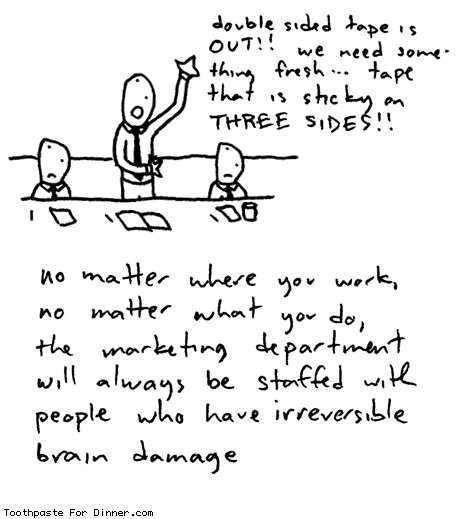
Memo to Marketing Teams and Advertisers -- Quit Your Jobs and Go Home, You're Failing


Comedian Bill Hicks was known to ask his audiences, "Are there any people who work in marketing here tonight?" When a few drunken louts cheered or applauded, or otherwise made their presence known, Hicks would calmly follow-up with, "Good. When you go home tonight, kill yourselves."

It's been eons since I last listened to commercial radio. Even as a teenager, I owned enough cassette tapes (now CDs) to listen to music for days on end without hearing the same song twice. It's been different with television because I've always enjoyed television. I'm one of those "active viewers" who does not aimlessly surf channels, nor sit drooling, zombified before any old thing playing on whatever channel happens to be on when I flick the TV on. As a writer, as an educated person, it's fashionable or expected to say I shun TV. I really enjoy television, but over the past few years have come to shun it almost entirely. Not because of the so-called "reality shows" (shit, those wretched works of detritus only demonstrate how much writers are needed; Joe Blow and Jane Doe off the street are as boring as dogshit), or any other deficiencies in programming. No, I have come to hate television for one reason -- the commercials.

Even before my great distaste for television had fully formed, I'd always had a silent agreement with myself -- I would never buy a product I had seen in an advertisement. It's been a surprisingly easy pact to keep.

Times I do encounter commercial television, I've become more and more astounded, appalled and bewildered by what I see in advertisements. I understand what I see and hear -- that's what troubles me. Based on what I see, I've made a few guesses about the advertising industry (one of the few industries in which I've never worked):

* Obviously, people who make commercials are not paid -- no one would pay money for that work

* Clearly, makers of commercials were conceived in test tubes, reared in featureless padded cells, and work in sterile laboratories with only old in-flight magazines from defunct airlines as their connection to the world outside

* Marketing folk have no friends -- who could be friends or even casually associate with someone involved in polluting the world's consciousness with the insulting, stupid tripe that comprises advertising

* Advertisers have misshapen craniums -- like lawyers, advertisers' minds (or what passes for their minds) lack those regions in which creativity, intelligence, and conscience reside. As a consequence, their cranium vaults sag inward into the void

* Commercials causes physical illness -- watching or listening to advertising causes the functions of the human body to slow to such a degree that low grade rigor mortis sets in and viewers'/listeners' internal organs actually begin to rot, thus leaving victims prone to infection and compromised immune systems

I suppose it doesn't matter. With TiVo and downloading movies and TV shows from the Internet, viewers have more opportunity to skip commercials altogether. However, that does leave the physical landscape outside our homes at their disposal. Every time I'm on highway, seeing those obnoxious, endless billboards passing by, I think to myself, "And this is within the law -- incredible!"

Not that any greedhead advertiser is going to listen to me. But if some person involved in marketing is home some night, drunk, sitting at their PC in soiled clothing, surfing the Web, and comes across this blog posting -- listen to Bill Hicks.

Update 04/11/2006

See Slate's The Nastiest Wife on Television for an example of what I'm talking about. People couldn't possibly get paid to come up with this crap.

Friday, April 07, 2006

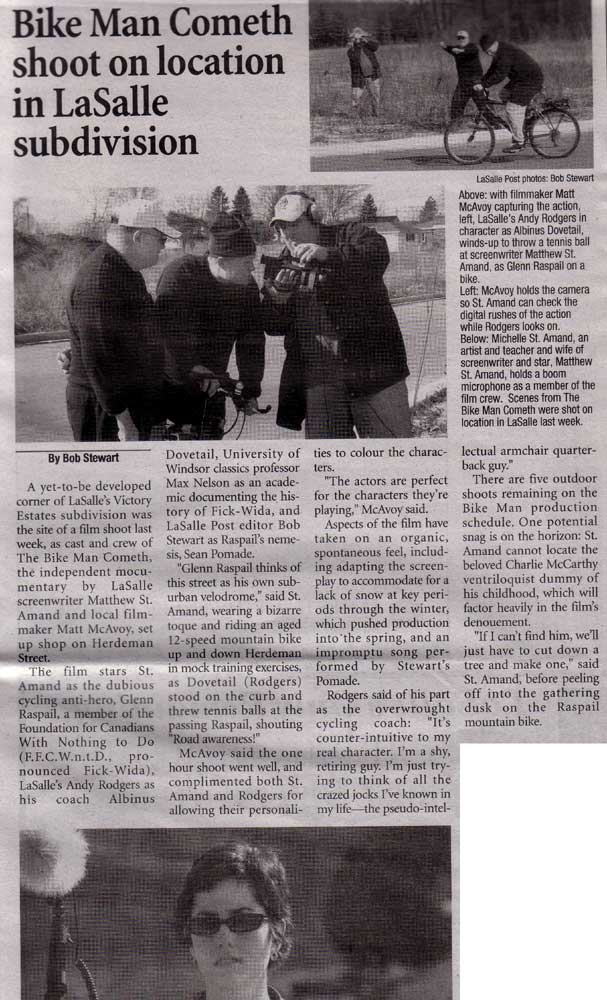
The Hollywood Experience (Treatment) in My Own Hometown

Last summer I joined a film group organized by wedding videographer who sought to branch out into making feature length movies. Although the brainstorming sessions grew copious and tedious, after a number of weeks the group (about a dozen regulars with a few scattered curious joining on various occasions) came up with a premise for its first film: a family driving in a car on their way to a funeral. As a practicing writer for the past fifteen years, and a publishing writer for the past seven years, this is the type of premise I would never conceive of touching. Years of reading and scribbling away at my work has served to Scotch-Guard my mind against cliches. Not that they don't still occur to me from time to time, but that there is nothing in me to give them purchase. They surface, quiver painfully in my imagination for a few moments, and then blow away like pollen. The film groups' premise couldn't have been more pedestrian, boring, lacklustre, inane, or trance-inducing if a team of malevolent philosophers set to the task of creating just that: The Worst Idea Ever.

As the brainstorming sessions teetered toward the inevitable, I saw it was time to excuse myself from the group. I was happy for everyone who was satisfied by the progress, but I, for one, have gotten to the point where I cannot be a part of projects that are not credible. I'm not nine years old anymore trying to draw an animated cartoon with my friends using highlighters and crayons. So, I bowed out quietly.

However, the contrarian in me -- the inverterate burlesque-monger and satirist in me -- could not simply walk away from The Worst Idea Ever. As a writer, I've only ever worked with my own ideas and my curiosity was pricked by the morbid challenge of working on this idea that not only originated outside of myself, but yielded so little promise. So, I had a go at it drafting an initial 20 pages of script. But the inner kamikaze who sometimes guides my steps wasn't satisfied with my toying with The Worst Idea Ever. No, it prodded me to collaborate with a friend and once-fellow group member. This person wasn't a writer, but that didn't matter. All a person needs are ideas. But this person had only one idea about our inaugural collaborative session: he would lead the writing of the screenplay (with me as typist). There was much to admire about his drive and willingness to "step up to the plate," but there was unmissable, inherent folly in the idea, as well. Thirty seconds into hearing his ideas on how to conduct our collaboration I saw that he would unintentionally have us tread the selfsame minefields I had spent a decade and a half learning to avoid. Questioning the basis for his creative outlook only inflamed him. The situation was so obvious it almost defied analogy -- but here's one: you have two guys, one is an auto mechanic, the other knows nothing about cars. Who are you gonna trust to work on your car?

So, the collaboration was stillborn and so seemed my 20 pages of script in which emerged five characters: father, Gerhard Schwanghammer, who went by "Gerry," his wife Grace, their daughter Abigail, son Andy, and the deceased grandfather. Gerry worked a low-level job at a radio station, Grace was a piano teacher, Abigail a disaffected teenager, and Andy a quirky, annoying kid with a fetish for stand-up comedy, and deceased grandfather who popped up in the car with wry memories and observations about the volatile family.

After some back-and-forth email with the leader of the film group, I commenced to see where Grandpa, Gerhard, Grace, Abigail and Andy took me. I titled the script Mr. Brightside.

It took me six days to write the initial 86 pages. After meeting with the film group leader, who said everyone was excited by the excerpts I had sent to them. At the group's request, I took another few days and brought the page-count up to 112 pages. I submitted the script to the film group leader, received his "Thank you for the gift of this script" email, and was dropped from his consciousness like a facialized whore in a darkened alley.

Yes, I left the group. Yes, I didn't seek to be a part of the production. All my choices. But that script was the work of my hand. Yes, I would be credited as the writer, but somehow not consulted when the need for changes arose. Just from a common sense perspective wouldn't it be the best route having the person who created the script make the needed alterations? Especially when no one else in the group could even come up with a script of their own? Not in this case, it seemed, where the tinkering commenced almost immediately.

Nor did I have the wherewithal to countenance the farce that was the "audition" process. Oh, I heard all about the pantomime of a search for the right "Gerhard," but in the end the leader of the group (now director) deigned to cast the group member who (in my experience) displayed the least amount of concentration, seriousness, or commitment of the entire group in the lead, as Gerhard Schwanghammer. This person was, coincidentally, a friend of the director's.

The immediate problem with that choice was that the script was dialogue-heavy. The lead roles demanded actors with professional experience. Unfortunately, the only two professional actors in the film group were relegated to menial, off-camera duties (though one eventually shone in a bit part). In fact, when one of these professional actors did audition, the director amazingly ran out of film just before it and thus was unable to show that audition to the rest of the group. Didn't matter because the auditions consisted of "cold reads" anyhow, and the professional actor (as anyone would) was described as "not connecting with the character." Hearing of the catastrophic casting blunder -- giving the "class clown" the lead role -- I wrote the director expressing my frank misgivings about his choice. Accusations were made regarding on whose behalf I was actually voicing my opposition. But my point of view was simple: creative projects like making a feature length film are fraught with difficulties. Why unnecessarily hobble yourself before getting out of the gate?

But there was to be much more hobbling to come.

First, the group didn't understand the genre of the script they received. The script was a drama with flashes of humor throughout. The group misinterpreted this and believed the script was a comedy. That's like being at the wheel of a vehicle you believe is an automobile, when in fact it's an air plane. There are some fundamental differences at play that must be understood.

Then the changes came (changes are inevitable, of course; my complaint is with the hackneyed, ham-handed, arbitrary way in which these were made -- never with any consideration about what the changes did to the overall story).

Gerry goes by "Gerry" through most of the film, except when his wife, Grace, is angry with him, and snaps, "Gerhard!" It's not very funny insolated like this here. Read the script, you'll see how it adds texture to the characters. The director trashed this. No one in the group understood the use of the two names.

Tedious flashback scenes were added to the film involving the deceased grandfather. And characters were added. For instance in the middle of the movie, while at a hotel, daughter Abigail goes down the hall to the soda machine. There, she is accosted by a wan, failed Mormon. Someone in the film group raised the question, "Don't Mormons go around in pairs?" This may be true, I don't even know, but rather than accepting that possibly this failed, lone Mormon -- banished to missionary work in this lost burg -- is so hopeless as to be sent into the world with no partner, the director simply added another Mormon. This changes the dynamic of the scene entirely: You have a lone teenaged girl now confronted by two men at the end of this empty hallway. Humor turns into menace. A complete wrong turn.

Better yet was the addition of a transvestite to the diner scene in which the family is eating breakfast. Why not go for the cheapest, least substantial laughs imaginable? The director, in a fit of creative gusto and ecstacy, decided that the breakfast scene absolutely demanded a campy transvestite enter the restaurant to give the film that nanosecond of mirth as the entire place turn and look in surprise.

How do I know of these things, and more, having excused myself from the group before production commenced? I know. If the group met at the bottom of a missile silo, I'd know what was happening with my work.

Unfortunately for the production, the girl playing Abigail quit the project entirely. I feel for the cast and crew because this loss effectively destroys the second half of the film. I don't know as yet if any firm solution has been arrived at to deal with this, but one idea I heard was bandied about involved the daughter simply disappearing with none of her family particularly concerned where she had gone. At the end of the movie Grace, the mother, would receive a cell phone call, smile, and announce that daughter Abigail is safe and sound -- somewhere.

To be fair, this production is the film group's first effort. It would be entirely unfair to expect perfection or even a sturdy level of competence from them (anyone) at this point. No zing intended on that. Especially with filmmaking where there are so many tangible, technical aspects to be mastered. When attending the meetings, it was my opinion that the group wouldn't produce anything of competence or consequence until -- at least -- its fifth or sixth project. I know about the learning processes involved with creative work. There is no way to rush it; no easy way around it. And I do admire the group's willingness to forge ahead in the face of setbacks.

One thing never changes with regard to creative projects -- they are created one decision at a time with each decision's impact having a knock-on effect throughout the entire work. Edits, revisions, alterations are inevitable in any work, but they should never been made simply so someone can leave their own fingerprints on a work. Also, I firmly believe in running with peoples' strengths. If you have a professional writer at your disposal, trust him with matters relating to the script. You have some professional actors, use them onscreen. I'm making short films with friends at present and this is our strategy, and it's working out great.

Ultimately, my feeling about this is "shame on me." I brought this (whatever "this" is) on myself. I should have known no matter whom I delivered my script to it would be treated like a drunken cheerleader at a fraternity keg party. It's just one of those laws or rules that greases the wheels of the universe.

Monday, April 03, 2006

Lateral Life - If a Book Falls in the Forest Does Anyone Hear It?


I'm in the midst of watching again the documentary Stone Reader about Mark Moskowitz's quest to find author Dow Mossman who wrote the 1972 novel The Stones of Summer.

After reading a review in 1972 that declared The Stones of Summer the "novel of a generation", Moskowitz bought a copy, read some of it, and put it away unimpressed. Years later, however, he rediscovered the novel and came away thinking it was one of the best books he'd ever read. He then set out to read everything else Dow Mossman had written -- and found that Mossman hadn't published another book. In fact, it was as though Mossman had dropped off the face of the earth. So, Moskowitz set out to find him, which he documented in his film Stone Reader.

Watching this film again, it's got me thinking about what I get from books. I'm in a period right now in which I feel ravenous to read. I've never been a particularly fast reader, plodding through books, taking weeks to get through the slimmest novels. Then I have periods during which nothing satisfies. My personal library is invisibly pocked with countless half- or quarter-read novels. It's frustrating when I get into one of those inconsolable spins. At present, I'm at the other end of the pendulum swing, enjoying everything I pick up. Last Monday I read Ken Bruen's crime novel The Dramatist. On Wednesday I began Louise Welsh's Tamburlaine Must Die. On Friday I picked up Michel Faber's massive The Crimson Petal and the White, of which I had only read 240 pages a couple of years ago. I read as much over the weekend, and am now a little more than halfway through the near 900-page novel.

The simplest way to sum up what I get from book is the lateral lives they open to me. Bill Vitanyi's Kyuboria, Fred Exley's A Fan's Notes, Ken Bruen's Jack Taylor novels are all set in familiar territory: office life, bar rooms, urban Ireland. Yet they offer me insights my own seared and sucker-punched senses didn't pick up when I was in similar circumstances. Then there's the work of Tim O'Brien and his Vietnam stories opening a portal onto experience that has never been a part of my life. The final section of his book The Things They Carried is about the truest, most wrenching writing I've ever read, when he speaks about a little girl named Linda whom he knew in elementary school.

It's not so much that books and stories are opening doors on aspects of life I know nothing about, it's more like they educate me about what my own experience has meant to me.
I remember so vividly one day when I was six years of age standing in the school yard of Sacred Heart elementary school in Windsor, Ontario -- seven houses away from my own home -- watching a fight between two boys a couple of years old than me. One horrible aspect of watching this fight from a dozen yards away was seeing that no one around the scuffling kids paid them any notice.

At one point, one kid flipped the other onto the ground, where the subdued kid sat, stunned, dust rising around him. It seemed the fight was over with, and all of the anxiety that chaos and entropy and fear of physical violence caused me could tuck itself back away in my mind and await the next outward eruption of turmoil to latch onto. However, the fight was not finished. As the boy on the ground sat in stunned ignorance, the boy who had flipped him walked over to the edge of of the school building, which was only a couple of yards away. There he picked up a piece of jagged concrete that had been knocked loose from the school's foundation. The hunk of concrete was big enough to require its carrier to use two hands to lift it. And the kid who seemed to have won the fight turned from the school wall, lugging that large piece of concrete, approached his adversary from behind, and dropped it onto his head. Witnessing this, my nervous system went incadescent.

Until that moment, in the neverending loop of my own fears of schoolyard violence, I had always figured being kicked in the face to be the worst thing that could happen to someone in a fight. That piece of concrete fell square onto the head of the kid sitting on the ground, hyperextending his neck so that his chin struck his chest under the blow. As the hunk of concrete fell to the ground, the injured kid sprang to his feet and ran in a circle. It was clear he was moving with no more purpose or thought than a foul ball ricocheting off of a baseball bat. The injured kid then ran to the school and banged on a classroom window. It was recess or lunch time so there was probably no one in the classroom. Didn't matter. At that moment, the teacher who was on yard duty came by. All she saw was a kid slamming his fast against a classroom window. Rather than helping him -- she had no idea what had just transpired -- she, in fact, gave him shit. My stomach felt like a well into which any rock thrown would take an eternity to hit water.

That was my first experience with true life horror.
And it was that first taste of the outside world that was reintroduced to me by Ken Kesey's observations about "The Combine" in his novel One Flew Over the Cuckoo's Nest or what faced Jim in Huckleberry Finn or Tom Robinson in To Kill a Mockingbird.

If books and stories are portals onto lateral lives we have lived yet not lived, or have lived and need examined by other minds for us, what of novels like Dow Mossman's The Stones of Summer, which are "lost"? Or, those used-bookstore-gems like Tom McHale's body of work, particularly his first novel Principato? Can we only find ourselves in bestsellers? Of course not. For me, the lateral life has never been more lush and open than stumbling across a work wholly unknown to me until the moment I discover it on a used bookstore shelf. Like Christopher Nolan's Dam-Burst of Dreams, or Scott Smith's A Simple Plan, or Thomas Tyron's The Other, or Terry Griggs' Quickening, or Richard Grayson's Highly Irregular Stories, or Mark Twain's Letters from the Earth, or Larry Brown's Big Bad Love, and so many others.

Beyond lamenting my own obscurity, there is a writer I know and whose work I have read living in Iowa whose books and plays should be in every bookstore and on stages across North America. His name is Gary Britson. I interviewed him last year for an article titled Authora Non Grata: Interview with the best writer you've never read. I have read two of Britson's novels, half a dozen of his short stories, and a couple of his plays. He is an excellent writer whose wry sense of humor continually takes me by surprise the more of his stuff I read. But for some reason book publishers and theatrical producers deign to ignore his work. Our loss.

I have a copy of Dow Mossman's The Stones of Summer. I tried reading it the day I bought it two years ago, and didn't get far. The writing is exceptional, but dense and with little sense of story developing. I set it aside to read other books, but will get back to it. The documentary made about Mossman's rediscovery is a worthy testament to all "lost" novels that moved someone somewhere. It's wonderful hearing the filmmaker Mark Moskowitz speaking to people about the books that meant so much to him, and to hear of authors and titles I'd never read. All those lateral lives out there. All those clues strewn about bookstores, in attics and basements, in boxes gathering dust.

As a writer, it's heartening to imagine that something I might create may one day mean as much to some reader somewhere as Mossman's novel means to Moskowitz. At present my most frequent strangers speaking my name are bill collectors. Manuscripts are piled in my office and in my basement like mute, outsized doorstops. Beyond my desk, I'm unemployed Matthew St. Amand, deficient Matthew St. Amand, always-looking-for-a-job Matthew St. Amand. But as a reader and a writer, I flourish in my lateral lives where my victories suffer under paradoxes similar to Flann O'Brien's mystic elevator in his novel The Third Policeman that descends into heaven/hell -- I can take nothing back to my own life except myself.

Wednesday, March 22, 2006

Americans don’t live here any longer

What’s Become of Americans?

By Paul Craig Roberts

03/22/06 "LewRockwell" -- -- Imagine knocking on America’s door and being told, "Americans don’t live here any longer. They have gone away."

But isn’t that what we are hearing, that Americans have gone away? Alan Shore told us so on ABC’s Boston Legal on March 14:

When the weapons of mass destruction thing turned out not to be true, I expected the American people to rise up. They didn't.

Then, when the Abu Ghraib torture thing surfaced and it was revealed that our government participated in rendition, a practice where we kidnap people and turn them over to régimes who specialize in torture, I was sure then the American people would be heard from. We stood mute.

Then came the news that we jailed thousands of so-called terrorist suspects, locked them up without the right to a trial or even the right to confront their accusers. Certainly, we would never stand for that. We did.

And now, it's been discovered the executive branch has been conducting massive, illegal, domestic surveillance on its own citizens. You and me. And I at least consoled myself that finally, finally the American people will have had enough. Evidently, we haven't.

In fact, if the people of this country have spoken, the message is we're okay with it all. Torture, warrantless search and seizure, illegal wiretappings, prison without a fair trial or any trial, war on false pretenses. We, as a citizenry, are apparently not offended.

There are no demonstrations on college campuses. In fact, there's no clear indication that young people even seem to notice. . . .

The Secret Service can now declare free speech zones to contain, control and, in effect, criminalize protest. Stop for a second and try to fathom that. At a presidential rally, parade or appearance, if you have on a supportive t-shirt, you can be there. If you’re wearing or carrying something in protest, you can be removed.

This! In the United States of America.

Readers tell me that Americans don’t live here any more. They ask what responsible American citizenry would put up with the trashing of the Bill of Rights and the separation of powers, with wars based on deception, and with pathological liars in control of their government? One reader recently wrote that he believes that "no element of the U.S. government has been left untainted" by the lies and manipulations that have driven away accountability. So-called leaders, he wrote, "talk a great story of American pride and patriotism," but in their hands patriotism is merely a device for "cynical manipulation and fraud."

The Bush regime acknowledges that 30,000 Iraqi civilians, largely women and children, have been killed as a result of Bush’s invasion. Others who have looked at civilian casualties with greater attention have come up with numbers three to six times as large. The Johns Hopkins study accounted for 98,000 civilian deaths. Patrick Cockburn, using more sophisticated statistical analysis, concluded that 180,000 Iraqis died as a result of Bush’s invasion. The former prime minister Iyad Allawi says that Iraqi sectarian violence alone is claiming 50–60 deaths per day, or 18,000–22,000 annually, a figure that could quickly worsen.

Some were killed by “smart bombs” that weren’t very smart and dropped on hospitals, schools, and weddings. Others were mistaken for resistance fighters and killed. Still others were killed by spooked, trigger-happy U.S. troops. And many died due to the breakdown of the Iraqi health system.

Now comes a report in the online edition of Time magazine that U.S. Marines went on a rampage in the village of Haditha and deliberately slaughtered 15 unarmed Iraqis in their homes. The Iraqis were still in their bed clothes, and 10 of the 15 were women and children.

The Marines turned in a false report that the civilians were killed by an insurgent bomb. But the evidence of wanton carnage was too powerful. Pressed by Time’s collection of evidence, U.S. military officials in Baghdad opened an investigation. Time reports that "according to military officials, the inquiry acknowledged that, contrary to the military’s initial report, the 15 civilians killed on Nov. 19 died at the hands of the Marines, not the insurgents. The military announced last week that the matter has been handed over to the Naval Criminal Investigative Service, which will conduct a criminal investigation."

If this story is true, under Donald Rumsfeld and George Bush’s leadership, proud and honorable U.S. Marines have degenerated into the Waffen SS. Those of us raised on John Wayne war movies find this very hard to take.

A fish rots from the head. Clearly, deception in the Oval Office is corrupting the U.S. military. One reader reported that on March 19 his local PBS station aired a program which discussed the deaths of two young American soldiers in friendly fire incidents similar to Pat Tillman’s death. In each case, he reports, "elements within the military falsified reports and attempted to shift blame to either enemy combatants or allied (Polish) forces."

The neocons have yet to tell us the real reason for their assault on Iraq, which has so far produced 20,000 dead, maimed, and wounded U.S. soldiers, between 30,000 and 180,000 (and rising) dead Iraqis, and demoralized U.S. Marines to the point that they commit atrocities on women and children.

Would real Americans accept these blows for the sake of an undeclared agenda? Perhaps it is true that Americans don’t live here any longer.

Dr. Roberts is Chairman of the Institute for Political Economy and Research Fellow at the Independent Institute. He is a former associate editor of the Wall Street Journal, former contributing editor for National Review, and a former assistant secretary of the U.S. Treasury.

Sunday, March 12, 2006

Deflated "Dr. Howdy" the SPAMMER cries "Uncle!"

Part I

See if you can follow this chain of events:

* SPAMMER "Dr. Howdy" posts on my blog -- where any and all opinions (except those from exposed SPAMMERS) are welcome

* Soon after SPAMMER "Dr. Howdy" posts here I receive an onslaught of SPAM from SPAMMER "Dr. Howdy"

* I write to "Dr. Howdy" asking to be taken off his emailing list. I hate the kind of stuff with which he fills his "newsletters"

* Nothing happens; SPAM from "Dr. Howdy" continues to arrive

* I visit "Dr. Howdy"'s convoluted laugh-at-the-SPAM-victim unsubscribe page and find that the so-called information I require to get off his list is not in the email newsletter he sends to me

* SPAM continues to arrive from "Dr. Howdy"

* One too many items of SPAM arrives from "Dr. Howdy" and I vociferously communicate my displeasure to him. To which "Dr. Howdy" makes no offer to unsubscribe me, but weirdly informs me that someone else signed me up for his newsletter (something I am going to pursue and investigate with Yahoo! Groups until I'm satisfied)

* I ask "Dr. Howdy" the SPAMMER to identify who signed me up for his lame newsletter -- no reply about this; a hollow pantomime of "ethics," no doubt

* I write a blog posting here unmasking "Dr. Howdy" as a SPAMMER -- squishy blind things that dwell beneath rocks hate it when they are exposed to the light

* "Dr. Howdy" posts on my blog, contrite, tail-between-his-knocked-knees, saying, "Hey man, what's the problem? Anyone can unsubscribe from my newsletter any time." This is an outright lie -- if it were that easy, I would not have had to go to all of the trouble of unmasking "Dr. Howdy" as the SPAMMER he is

"Dr. Howdy" and his kind (i.e. SPAMMERS who scoop peoples' email addresses without their knowledge or permission and then plague these unsuspecting victims with SPAM) are not welcome inside the hotdog factory.

After numerous verbal squirts of Murphy's Oil Soap on "Dr. Howdy" via his blog, hoping simply to get my point across that I want him to leave me alone, he sulks and skulks around here, whining like some wounded thing. When, in fact, he has proven to have the resilience and soul of a cockroach. I'm not fooled.

So let this put "shut" to this miserable situation.

P.S. Howdy -- my readers are not only well familiar with my use of bad language, it's often applauded. Posting an edited version of one of my missives to you in the Comments section of a posting will shock no one.

Friday, March 10, 2006

Catch a SPAMMER By the Toe... Dr. Howdy of "Thought & Spam" Fame, You're Going Down

I have caught a live, active SPAMMER and his name is alternately "Dr. Howdy" or "Professor Howdy".

Interested in telling an honest-to-God spammer how you feel about such people and their chosen method of spending their spare time? Contact this puss-filled miscreant at the following: http://www.blogger.com/profile/5577144 (emailnewspaper@charter.net).

This cretin has been in my life for about three or four months now. One day he posted on my blog, the next day came this plague of unwanted email newsletters purporting to be of a "humorous" nature. They're not. They're lamer than the lamest "office humor" that used to cripple fax machines. Since the first rancid missive, I have attempted to get myself off this myopic jerk's emailing list. Today I received the last spam I'm willing to receive from this jackass, Dr. Howdy. As of this evening, Dr. Howdy is going down.
2 of 116 comments on the supposed "unsubscribe" page of the Dr. Howdy Lame-O Web site:

Your unsubscribe information is idiotic and makes absolutely no sense. My 11 year old brother could probably make a more technologically sophisticated blog and newsletter than this one. I have tried repeatedly over the last year to get off this email list. I guarantee that I WILL find a way to report you to some sort of Yahoo internet authority if I recieve anymore of your "i am hilarious and jesus loves you" crap in my inbox. I am way too busy to try to sift through all the howdy garbage I receive in my inbox daily. If I ever come across a college student who knows about and actually enjoys this email, I will be sure to punch them in the face.

Also:

Howdy is okay....it's the horrendeous amount of terrible spam I've been getting lately that I can trace directly back to Howdy's email /blogs. Shame on YOU!

Dr. Howdy the SPAMMER's reply:

Oh you found me out.
I knew I should have
been content with just
causing the earthquake
in Pakistan as well as
Hurricanes Katrina
& Rita, but just last
month I decided why
not cause one of my
faithful readers since
Apr 2, 2004 to start
receiving lots of SPAM.
Oh, you found me
out.

Actually in reality, I was
offered $1.5 million for
your e-mail address by
a Spammer. So now I'm
rich and you have to live
with SPAM!!!

Now you have discovered
the real reason for 'T & H'
and why I spend 70 hrs./week
for the last 8 years in sending
out this publication to well
over 2 million folks.

Fortunately for everyone
else's sake, I don't plan to
sell their addresses because
now I'm filthy rich...

Very Sorry,
Howdy
Getting a mental picture of this idiot? His email address is emailnewspaper@charter.net.

After a few cutting messages from me today, Dr. Howdy the SPAMMER informed me that someone else was kind enough to sign me up for this daily detritus. Yes, someone signed me up for this crap without my permission. Someone who obviously knows me well and knows how much I relish gum-on-the-shoe Internet humor. And Yahoo! Groups is more than glad to be this SPAMMER's enabler. I guess Yahoo! is too busy turning information over to Chinese authorities for the jailing of journalists to be bothered sending out verification email messages when someone signs up for one of its groups' newsletters. And it's not like Dr. Howdy the SPAMMER is going to request permission because who would give it? No one. The newsletters are the most infantile, thoughtless garbage you can (or can't) imagine. Makes the pizza parlor fliers you get in the mail seem like literature -- at least the pizza fliers have coupons! As for unsubscribing, Dr. Howdy the SPAMMER refers people to his ridiculous, convoluted page, which is quite obviously a joke on anyone seeking to unsubscribe.

So, just for starters, the moment I'm finished with this post I'm going to report Dr. Howdy the SPAMMER to Blogger.com and Yahoo! Groups, that wretched outfit that makes signing people up without their permission for such newsletters possible in the first place.

Let's see what Blogger.com thinks about this scumbag using its free service as an online "base of operations" for finding victims for his SPAM. And let's see if Yahoo! can bother its ass to reply to the multiple complaints I have sent in regarding its very lax and irresponsible monitoring of who signs up for its newsgroups.

I hate spammers.

Update 03/11/2006:

No big surprise, but it seems our nefarious "Dr. Howdy" is a liar as well as a SPAMMER. I have contacted everyone in my email address book and no one claims responsibility for signing me up for "Dr. Howdy's" SPAM. Unlike "Dr. Howdy," I deal with honest, truthful people. I imagine lowly "Dr. Howdy" SPAMMING me and his many other victims on a wireless laptop, holed up in a decrepit toilet stall in a fetid, forgotten MENS room in some abandoned rail or bus station. "Dr. Howdy" doubtless deals only with liars and thieves, addicts, cross dressers, and child molesters. His word is not to be taken.

However, on the off-, off-, off-chance a syllable of truth has entered "Dr. Howdy"'s vocabulary, I have demanded he provide me the email address of the brain damaged person who signed me up for his vomitous newsletter. So far, no reply on this. It's impossible to imagine "Dr. Howdy" objecting on anything approaching ethical grounds. What ethics? This moron is a SPAMMER. And given the high tech production value of his "newsletter", he can no doubt lay his hands on the email address of the ignoramus who signed me up for his drek.

Friday, March 03, 2006

Incidental History - My Childhood Home Goes Up For Sale

After 40 years living at the same address, my parents are selling their home. As Thomas Wolfe wrote in his essay "The Return:" "I was a child here."

My family had a large console television in the basement; the only TV in the house until I was about ten. My father was a elementary school principal and sometimes brought home a tiny black and white television on weekends. We set it on the stereo cabinet in the living room for my younger brother and I to watch Wonder Woman and The Incredible Hulk and Delta House (the shortlived TV spinoff of Animal House) while my parents watched their shows in the basement. It was on that small black and white set that I saw Animal House when it was broadcast on network TV for the first time. The film had the effect on me that the ceiling of the Sistine Chapel has on most adults: It was a revelation. After seeing John Belushi's legendary scene in the Faber College cafeteria, ludicrously loading up his tray, stuffing whole sandwiches, Jell-O platters, and hamburgers into his mouth, my eating habits forever changed. During lunches, I stuffed whole peanut butter and jam sandwiches into my mouth, to the shrieks and confusion of my mother. How I missed choking to death, I'll never know.

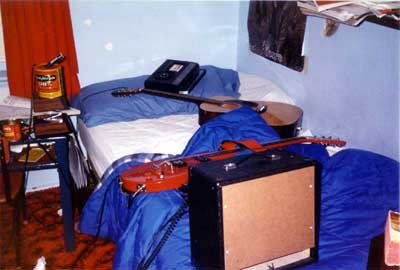
Beyond the right-hand upper floor window was my bedroom in which I wrote my first song with I was twelve. I had been playing guitar with more passion than expertise for about two years by that point. After creeping through the age-old Standard Guitar Method series, which had me plucking dissonant notes for months on end, I revelled in strumming full chords. Around this time I saw Woodstock for the first time and sought to emulate Richie Havens' bombastic strumming style. Having no ear for learning to play songs just by listening to them, I practiced my chord-changes and slowly learned to combine them in ways that sounded good to me. All laborious key-of-G, but it was a like a door on the universe opened a crack through which I made my own contact with the invisible hand that guides creativity.

I was the only oldest sibling among my friends. All my buddies had older brothers, some of whom were as much as a decade older, and from these surly, impatient older brothers we learned about music (among many other sordid subjects). Detroit FM radio was all we listened to: 101.1 WRIF, 98.7 WLLZ, and a slew of other here-today-gone-tomorrow stations. While so many people today are revealing their closet-affinity for 1980s music -- all the techno-pop crap that made absolutely no impression on me -- my friends and I listened to the best of 1980s rock 'n' roll: Billy Squire, the J. Geils Band, The Cars, Jefferson Starship, Aldo Nova, The Romantics, Rush, .38 Special, Bitter Sweet Alley. The first cassette I ever purchased was The Rolling Stones' Tattoo You in the music department of Zeller's in the Ambassador Mall in 1981, when I was ten. When the Stones came to Detroit during that tour, months later, it was like a visitation from Moses or Ezekiel; someone from On High. The eldest brother of my friends next door actually saw the Stones at Cobo Hall in Detroit. Afterward, I looked at him as though he had been to the top of Mount Sinai and had the soot from a burning bush on his cheeks and forehead.

By the time I was twelve I had an ancient black and white television in my bedroom; yellowed plastic faceplate, the entire set bolted to a frail wheeled stand. It stood at the foot of my bed. Those were the days before my family had Cable. Still, that TV pulled in a decent number of Canadian and Michigan stations. However, there were only two UHF stations that mattered to me: WKBD Channel 50 and Channel 56, Detroit Public Television. Channel 50 filled me with reruns of Sanford & Son, Happy Days, Three's Company, CHiPs. But most importantly there was the Channel 50 Eight O'Clock Movie, which played every modern classic film imaginable: The Deer Hunter (uncut), Marathon Man, Coming Home, Taxi Driver, Sleeper, and dozens and dozens of other films that shaped or warped me into the person I am today.

The highlights of all this television-watching came every night at 10:30 on Channel 50 in the form of The Odd Couple, starring Tony Randall and Jack Klugman. Then at 11 p.m. came a double shot of The Twilight Zone. At midnight were Comedy Classics, which alternated between Three Stooges films and Laurel & Hardy.

On Saturday nights, it was Channel 56 at 10 p.m. to watch Monty Python's Flying Circus, which was followed by a local music video show called The Beat. I cannot overstate the importance of The Beat on my life. Hosted by longtime Detroit DJ, Doug Podell, the show was simulcast on 98.7 FM, allowing me to tape the music from the show on cassette. It was on The Beat -- a makeshift production with all the showy frills of early public access television -- I first saw U2's video for "A Sort of a Homecoming", and on which I saw the newly unearthed footage of Jim Morrison and The Doors performing "Love Me Two Times" in Europe from 1968. Jim Morrison was among my first cultural titans -- whether deservedly so, or not, I'm still deciding -- and by that night in 1983 I had only ever seen black and white photographs of him; heard the radio tracks from Doors' albums on WRIF. Seeing actual footage of Morrison and the Doors was like being handed the Shroud of Turin for personal inspection. It might sound strange in this age where we can't escape music videos or tiresome celebrities, but at that time there was such a dearth of Doors' material outside the official canon of ordinary album releases and the very rare magazine article. I videotaped that performance of "Love Me Two Times" and watched it until I had memorized every frame of it. Soon after came release of the video constructed around the Doors' performance of Van Morrison's song "Gloria," which was also a minor seismic event in my life.

The basement of the house was finished around the time I was born. As a kid, I was avid about cartoons and cartooning. My parents were kind enough to buy me a desk where I worked on drawings and comic strips. By the time I entered high school, my interests had shifted to music and would soon shift further to fiction writing. It was down in that basement, with my levithan tape cassette collection at my side, my portable radio/tape deck next to it, that I began writing. Within months of composing my short story I tried my hand at novel writing and made the disovery that writing a novel was more than simply writing a lot of words. Armed with an IBM clone PC and a Panasonic dot matrix printer, I churned out the pages day after day, submitting stories to Weird Tales, Story, Amazing Stories, Haunts, and countless other journals and magazines. Every single one of those stories rejected as quickly as the mail would allow.

It was there in the basement, in 1990, that I first began writing a story called "The Block Buster", which soon expanded into a novel-length idea. My first genuine crack at the story spanned 184 pages. My second draft came out to 464 pages. Years passed, I tinkered with draft after draft of the novel, changing the title to "Bad Moon Rising," and then finally to Randham Acts. All the while I had other projects on-the-go, and eventually got to a point where I tried simply forgetting about Randham Acts. But the story persisted and I eventually completed what felt like the definitive draft, which I submitted to Better Non Sequitur, a small press publisher in San Diego, California. The night I received the email saying BNS accepted Randham Acts, the decade and-a-half I'd spent writing the novel seemed to accordion into a surreal blur of notes and drafts that lost all detail.

And so that house on Cameron Avenue is up for sale. I was a child there. I first heard music there, read my first book there. The feeling I have about it resembles what I experienced when losing girlfriends in my youth -- terminally ordinary. The consolation is that "ordinary" is not at all a bad state of being in which to exist. That ordinary house on that ordinary street on the west side of Windsor, Ontario provided me all I needed with regard to inspiration, environment, atmosphere, mood, color, texture, not to mention shelter. I'll miss the old house. As it watches my folks pack up and leave in the next few months, the house will doubtlessly be left knowing it had been lived in.

Tuesday, February 28, 2006

Who Would Have Guessed? An Interesting News Day

Office Lit -- The "Beowulf" of the 21st Century

Stephen King rightly wonders in his non-fiction book On Writing why so many readers enjoy his stories involving jobs and places of work. As a person who despises corporate life, yet enjoys office-satire stories, I concur that this is a strange phenomenon.

After working a surreal year at a company called Engineering Animation, which was bought up by Unigraphics Solutions soon after I was hired, and ultimately swallowed by E.D.S. -- which led to my blessed lay-off -- I was inspired to write my own office farce, Der Komplex. My unnamed protagonist muddles through the same hyperbaric-chamber-environment I encountered at E.A.I., where there was no defined job description, no real workload, no tangible responsibilities, no measurable results; nothing but an unpleasant tingling at the top of the head that throbbed like a warning beacon.

Bill Vitanyi's slim novel Kyuboria is a first rate office satire. It follows the exploits of State employee Clint Palmer, a programmer who seeks to open and run his own business. This far-off dream suddenly seems attainable when he reads of a government sponsored grant offered to people fired from the I.T. industry (if such a grant existed, I would be eligible for it three times over). However, Clint soon learns that getting fired from his job is not so easy. In fact, it's virtually impossible. Comedy and painfully-rendered-reality ensue.

My own surreal experiences in I.T. did not end with my lay-off from E.A.I. After nine months of job hunting, I landed a technical writing job with a company in Dexter, Michigan. The company was called Creative Solutions, and I remember feeling a rush of excitement as I sought out its Web site, wondering what sort of work went on there (yeah, sorry HR wonks, I don't just "multi" submit my resumes, I mega submit, so I never have much idea -- in total -- where I've sent my C.V.s). Did they do digital animation? Innovative Web marketing? Magazine work?

Turned out Creative Solutions created and sold accounting software. My twelve-month tenure there saw me steeped in the United States Internal Revenue Service tax code. Although my colleagues were a wonderful, incongruously creative bunch, the job had me doing the devil's own busy-work. All of which was bookended by a 106-mile daily commute. The pay was good; there was even profit sharing. But the brass tacks of the job itself was like something from a nightmare: so deadly, so mercilessly boring was it that I could not concentrate on my tasks for even a few minutes without glazing over. After crashing my car, one morning, into the rear end of a tractor trailer United States Postal vehicle, I somehow managed to find a job in my own hometown.

Enter McIll. That's not the name of the company, but it's close enough. McIll designed and created computer- and Web-based training products. The job, as described to me by a recruiter, sounded terrific. The company was on the rebound from having been bought up by a larger corporation, virtually gutted, nearly eviscerated, before the larger corporation sold the place back to the two guys who had started McIll years before. It was a great local story.

And then the owners plunged a blood-guttered dagger into the side of the place -- they hired a consultant.

I'll never forget this battered, waify woman introducing herself to the company -- about fifty employees at this time -- referring to herself as, among other things, a "life coach" and corporate consultant. She met with each employee individually, and I was stunned to find during my meeting that the woman appeared barely able to read. All employees had to fill out forms about what changes they wanted to see implemented in the company. She read mine in front of me with a finger under the line she read, and her lips moving, her whispered voice stumbling over every other word.

And so the process of turning a modern, cool office space into an I.T. Wal-Mart. The dim, dark-painted upper floor where I was stationed was repainted, everyone relocated to the mainfloor where fluorescent hell beams blazed above all day long. The designers who needed to work in dim confines wore sunglasses to combat the glare. The staff was corralled into a mass of desks in an open room, reminiscent of the hangar-sized office filled with typists in the early portion of Saving Private Ryan. Right out of the Tragically Hip's "My Music at Work" video.

A grotesque woman from Chicago with a dubious PhD was hired to act as smiling, soothing taskmaster. She struck me as the type who could hand out termination papers in a Christmas card. Her helmeted hair style echoed the old advertisement line "... hair is for protection..." She stalked around the office in her power suits and assailed us over the telephone from her "home office." And soon after the "life coach" consultant went her giddy way -- doubtless literally laughing all the way to the bank -- the helmet frau instituted a domino-fall run of firings. I was among the first wave and one of the very few who actually deserved termination.

From McIll I went to Hewlett-Packard in Dearborn, Michigan. Another hyperbaric chamber; an ant-hole filled with consultants. I remember they were all named "Bill." How painfully apt, because that's all they did: bill, bill, bill the company. Three months of that and my madness meter was nearly blown.

My forays into office life have been as fantastical and surreal as any Grimm Brothers story. The array of fractured personalities, along with the unaccountably cool folk, encountered in these enchanted forests defy description. Kindred souls met in the fog by copier, in the mist of the kitchennette, in the dungeon of the conference room. Our eyes met. Our senses of humor tickled one another. Then we disappeared from one another.

And it's heartening and entertaining to see that people are telling the stories of this strange land. Max Barry is now out with Company and maybe I will one day get beyond my traumas to complete my office-novel-in-progress Swimming Under Water.

Following my absolute last venture into office-life, I wrote Geek Barn as my farewell to that brain-damaged, soul-perforating purgatory.

Saturday, February 25, 2006

Good Show, Sex Pistols

The Sex Pistols have opted out on appearing at their induction into the Rock and Roll Hall of Fame.

Their response:

"It's my parade and I'll cry if I want to!" -- Protestant marchers are not welcome in Dublin, Ireland

By SHAWN POGATCHNIK, Associated Press Writer - February 25, 2006 - DUBLIN, Ireland - Several hundred Irish Republican Army supporters attacked police in Dublin on Saturday to protest an unprecedented parade through the capital by Protestants from Northern Ireland.

In scenes rare for the Republic of Ireland, protesters hurled bottles, bricks, concrete blocks and fireworks at police officers trying to clear the hostile crowd from Dublin's most famous boulevard, O'Connell Street.
If a person can only express himself by throwing a brick (or, a wheelbarrow, for that matter), then he has nothing to say. I do not side with the rock/brick/bottle-throwers who protested the "unprecedented parade through the capital by Protestants from Northern Ireland"; "a Love Ulster rally involving Orangemen and relatives of IRA murder victims". But this does not keep me from recognizing the Love Ulster members as pure and simple shit-disturbers. What empty lives these pruned orange bastards must lead when the pillar of their lives are these incendiary marches.

In 1999, the site of this parade and ensuing melee was my neighborhood. I lived in an apartment over the Spar on Westmoreland Street, on the other side of the O'Connell Bridge from where this fracas erupted. It is no place for a parade other than the brilliant St. Patrick's Day parade that will occur next month.

I'm reading much about the clash and how these poor, put-upon Prostestants meekly called off their parade, but I'm not reading why these people sought to march in central Dublin. Yes, we must condemn the violence that resulted, but will someone please answer why this march was planned in the capital city?

Democratic Unionist Party "lawmaker" Jeffrey Donaldson claims it was outside agitators who ignited the violence. I definitely group Love Ulster into this category.

During the two years I lived in Dublin, Ireland in the late 1990s, I found the city and country to be among the most civilized, pleasant and lovely places I've ever known. I walked nearly every neighborhood of Dublin City, some dodgier than others, and never had any trouble. I don't romanticize the Dirty Old Town; a city with that population has its problems. Whenever I saw the stirrings or making of "trouble", I shifted gears, changed directions, and moved to safer ground. But the city is not a tinderbox of sectarian hatred. The people I knew there really couldn't care less about mafia-like factions in the north, whether it be the bullet-headed IRA or the delusional royal imperialists.

I know Irish Catholic Republicans who live in the town of Crossmaglen in County Armagh. I have witnessed firsthand the intimidation tactics the British forces there use on the citizenry of aged farmers and families, flying their helicopters menacingly low over their rooftops. The afternoon I saw this happen -- in 1995 -- I raised my camera to photograph the oddity. The friend I was with nearly knocked the camera out of my hand, saying the British troops would likely shoot my face off if they caught me photographing them.

The British forces in Crossmaglen mercilessly harassed the populace there with random, violent searches of peoples' homes in the middle of the night. The soldiers used the butts of their machine guns to break up the peoples' dishes. They once poisoned the beloved dog of a farmer I know there. Soon after that poisoning, the British forces one night landed their helicopter in this farmer's yard and burst into his home. After breaking all of his dishes, the farmer had had enough. He fought back, taking the heavily armed soldiers by surprise, and using nothing but his fists and righteous indignation, he throttled half a dozen of them before finally being subdued. He was arrested on the spot and taken away in the helicopter. He was taken to a dungeon-like holding cell, stripped naked and left in the dank darkness. The judge who presided over his case saw how unrestrained and in the wrong the British troops who brought him in had been that the judge simply found the farmer guilty of "disrespecting the Queen's uniform" when he beat up the soldiers. He was given a small fine and released.

The IRA is widely viewed for what it is -- a mafia of unemployed thugs who fraudulently use "Republicanism" and "Irish Independence" as a ruse for raising money abroad. IRA members usually live in unaccountably lavish style and are woefully responsible for so much violence that is visited upon their countrymen -- either perpetrating it themselves (Omagh bombing; Robert McCartney who was stabbed and kicked to death by a gang that included at least three members of the IRA) or bringing it upon them with their own acts of violence against the royal imperialists in the region.

The Irish "troubles" as they exist today occur within a few blighted blocks of Belfast; in squalid, thug-infested, gnacker-ridden ghettos.

So, the Protestants of northern Ireland brought their damnable marching to Dublin City. Love Ulster has no right to march down O'Connell Street. They're peas-in-a-pod with their brick-throwing adversaries -- where one goes, so follows the other.

What a sad day for Dublin and for all people who love that city.
Editorial by Brendan O'Connor in the Sunday Independent: In case anyone had forgotten, violence is what republicans do

LEST you had been lulled into thinking republicans were all about chicks in mini-skirts and equality, we all got a good reminder yesterday what they're all about. Every schoolchild in the country and every Provo-suckered yuppie radical should have been brought into O'Connell Street to witness the aftermath of the battle of Dublin yesterday and been told: "Always remember, this is what they do and this is what they do best."

It was the kind of thing you'd expect in the Middle East, or in France. It was the kind of thing we like to think we're too civilised for in this country. It was the kind of thing you'd expect to see in Northern Ireland.

It was the kind of thing, don't forget, that the people of that state have lived with for nearly 40 years. And now it's down here too.

And let's not scurry to blame the people who've been repaving O'Connell Street for what seems like a decade now. Let's not blame the people who left that street like a building site, or a rioter's dream. We can't stop leaving building blocks lying around in case someone might pick them up and throw them at the cops. Should we ban glass bottles as well? They are the kind of precautions you need to take in a mad house.

It is republicanism, the violent tradition of republicanism, and indeed republicanism's reverence for violence, that allowed what happened yesterday to happen. They tore apart our town, they tried to kill our cops, they ripped our fire engines to bits. They attacked the heart of this country and the very people we trust to protect that heart and it is Irish republicanism's twisted morality that made this acceptable.

And let's not be fooled into thinking that this was about politics in any real way. This was about the sectarianism that is at the heart of republicanism in this country. This is about a group of people who would deny another group the very right to exist. This is about one tradition's heartfelt need to wipe out another tradition, to ethnically cleanse Irish unionists and Protestants and everything they believe in.

On this occasion they wouldn't even allow them to remember their dead. Republicans killed the people that were to be remembered on Saturday's march and as if that wasn't enough they shat all over their memory again this weekend. We should be disgusted at ourselves for allowing this culture to thrive, disgusted at what some of us have become, no more than animals. We should remember too that no matter how much peace they talk, republicans at their heart will do whatever is necessary, shamelessly so, to deny minorities their right to exist.

I met a foreigner on O'Connell Street. He asked me what had happened, and I told him, half ashamed.

"It's just like Iraq where I am from," he said. "People talk a lot about democracy and then do things like this. Because up here," he said, motioning to his head, "they never change. Ireland has been free for 80 years now but still nothing changes." It was a depressing thought.

Of course, he wasn't the only foreigner around. This happened in the heart of tourism country. This didn't happen in some kind of no go area. It kicked off next to Ireland's premier shopping street and moved on to even more salubrious and central areas of town.

And all the tourists were there - watching, horrified. Because everybody loves the Irish, after all. Nobody thinks we'd attack our own cops and attack other people just for being different or for disagreeing with us. But some of us did.

Republicans disgraced us internationally on Saturday. And you know what the most embarrassing thing is? The Orangemen got on their buses and quietly went home while we tore our city asunder. And they're supposed to be the crazy ones.


February 26 Letter to the Editor by Matt St. Amand: Brendan O'Connor writes at the end of his editorial about the February 25th riot in central Dublin: "The Orangemen got on their buses and quietly went home while we tore our city asunder" as though the Love Ulster marchers had nothing to do with the fracas that ensued. I have no respect for rock- and bottle-throwers -- if a person can only express himself by heaving a wheelbarrow at a police line, that person has nothing to say that I have time to hear. However, the damnable incendiary marching tradition of the North is just as much to blame for Saturday's melee. Marching Orangemen is a provocative sight. Everyone knows it, particularly the Orangemen. So, to characterize those Orangemen as "quietly" fleeing the rabid Republicans falsely casts them as blameless victims. Having lived above the Spar on Westmoreland Street for a year in the 1990s, I know the area in which this riot took place intimiately. I was saddned and angered reading what happened on O'Connell Street yesterday. Maybe outside agitators are to blame for much of the violence, however, the marchers of Love Ulster are plenty culpable for what took place. Why wouldn't they gathering at Trinity College or organize a rally in Phoenix Park? No, they are not satisifed until they've ruined the busiest day of commerce in the busiest city in Ireland by halting traffic and grinding everything to a stop with a march. Condemnation should be heaped upon the Republican rock-throwers, but the Orangemen of Love Ulster ought to be taken to task for organizing this unprecedented march in Dublin. Because everyone knows the Orangemen do not march to the beat of drums, but to the beat of gnashing teeth, to the beat of riots.

Update:

Read what a peace-loving northern Irish chick has to say about this posting -- which she evidently didn't read too closely.

My reply to said-chick: "I see my opinion has been as welcomed by you as those Love Ulster folks were welcomed in Dublin. Your attitude is just as much a part of the problem as marching and rock-throwing. There is not a single dot of hatred in my blog entry about the marches that were interrupted by violence in Dublin on Saturday, only the question why the Orangemen aren't being taken to task for provoking the violence that ensued. They are just as culpable for what happened. You would make a wonderful honorary right-wing American with your ability to slant my views and use your own venom to accuse me of hatred. My opinion is as valid as yours, and possibly more civilized.

"I would put my experience in Dublin up against yours any day of the week."

Saturday, February 18, 2006

New G.O.P. Fundraising Strategy


From CNN.com: Harry Whittington on being "peppered" with birdshot by Dick Cheney -- "My family and I are deeply sorry for all that Vice President Cheney and his family have had to go through this week..."
That's like the World Trade Center buildings apologizing to those hijacked airplanes. This is the world in which we live. Embrace it.

The American Republican Party has, and they're opening the field to creative fundraising. Rather than attending a boring $1,000-a-plate fundraisers, the G.O.P. will now allow contributors to give $1,000, $10,000 and $100,000 gifts in exchange for being "peppered" with birdshot by either the George W. Bush or Dick Cheney. Since it's such an honor for this to happen -- obviously Harry Whittington is embarrassed and contrite because he has so far paid Dick Cheney or the G.O.P. no money for his peppering -- this will be added to the Republican Party fundraising handbook. Let's hope as many Republican contributors as possible avail of this new way to give.

Contribution Scale:
  • $1,000 donation to the G.O.P. -- contributor will be peppered in shins and feet

  • $10,000 donation to G.O.P. -- contributor will be peppered in rear thighs and buttocks

  • $100,000 donation -- contributor will be peppered in chest, shoulder and choice of which side of face
Some precision shooting may be performed by Secret Service personnel under the supervision of George W. or Dick Cheney, or their proxies and designates.

Saturday, February 11, 2006

Film Critics, Why Do You Mine For Diamonds in a Garbage Dump?

Why do film critics of every mainstream media outlet continue to review the garbage spewed by Hollywood? I could understand this if CNN or USAToday were paid money by Hollywood film production companies to review their latest coiled piles of linked sausage. After years of working in video stores I was convinced the thumbs of Siskel & Ebert were for hire. Yeah, yeah, I've heard Roger Ebert's lame defense of why he's given a "thumbs up" on some pretty wretched fluff -- and I'm not buying it.

The latest Hollywood abominations I've seen reviewed star Steve Martin and Harrison Ford, but it doesn't really matter who the star of the moment is. Actors we've all come to enjoy and rely up (for their judgment in the work they choose, as well as their performances) are lining up to star in "celebrity welfare" projects. Need some examples? Look at Richard Gere or John Travolta's career choices in the last decade. I nearly wept when I saw Robert DeNiro star in Analyze That, sequel to the landmark comedy (ha!) Analyze This. DeNiro spent the first half of his career defining what brilliant acting was all about, and has spent the second half of his career destroying that reputation.

All the while there are some enormously talented, ingenius independent filmmakers who go completely unnoticed. These ignored filmmakers are not creating remote, high-brow art films involving sad clows in black and white. These original voices possess original visions and are creating fascinating, compelling work in virtual obscurity.

Update 02/17/2006:

I've enjoyed no greater discovery than that of contemporary Canadian cinema. For so long, we were saddled and harassed with "classics" like Goin' Down the Road and The Million Dollar Hockey Puck that we all watched more out of guilt and obligation than actual enjoyment. Well, there are some incredibly talented Canadian filmmakers plying their craft, and producing work that every serious film buff must seek out:
  • Finding Electra by Chris Pickle, a hilarious film about a loser-guy who enjoys being a stripper's boyfriend, but is soon dropped by her. The film documents his attempts to win her back.

  • How it All Went Down by Sylvio Pollio, a riveting drama based on a true story. Apparently Pollio had gone to film school with a guy who was a former drug dealer, who went back to dealing drugs in order to raise funds for a movie project. He thinks he can keep "the life" from swallowing him and his art whole, but his actions set his karma into a full tailspin.

  • Waydowntown by Gary Burns is a slick, smart, surreal comedy about a group of friends who work in a large office/mall complex who make a bet to see who can last a month without setting foot outside. I usually hate "bet" movies, but this film has so many genius, quirky moments and insights that it won me over immediately. Actress Marya Delver is mesmerizingly gorgeous in this film.

  • Treed Murray is a fantastic "one room" thriller in which "Murray", a business man, is cornered in a public park by a gang of thugs one afternoon. He escapes them by climbing a tree. After thwarting their initial attempts to get him down from his perch, Murray and the gang have an extended opportunity to engage one another in dialogue, analyzing, insulting, and gaining insight into the other.

  • Bar None by Mark Tuit, this is a hilarious, though rough-around-the-edges, indie film about a night in a Vancouver bar from the perspective of the bar staff. Mark Cunningham's script is excellent, and most of the performances are fabulous. Shot in black and white, the film has a great look, as well.

  • American Beer about four young Canadians on a roadtrip in the western U.S.A. is saved by its script, which is very funny and thoroughly unpredictable. The great setback with this film is that it's rife with horrible acting. However, the story and comedy are more than sufficient to make up for that.

  • The Cube trilogy should not be missed by any fans of futuristic/realistic science fiction. The story of these three films centers around a futuristic prison in the form of a seemingly endless maze of rooms, some of which are booby-trapped. The occupants of the cube have no idea whey they are there, and in most cases, don't even know their own identities. All three films in this series are highly recommended. Each has its flaws, but the scripts and performances more than outweigh any limitations posed by bland, anonymous setting.

  • Vinyl is an engrossing documentary by Alan Zweig about album collectors. By turns hilarious, poignant and informative, Zweig talks about his own obsession with collecting and interviews more than a few fascinating characters who have their own unique philosophies guiding their acquisitions.

  • Jesus Christ Vampire Killer by Lee Demarbre is a "rough-around-the-edges" gem that is as funny as its title leads the perspective viewer to believe. The writing is solid and innovative, the performances are -- for the most part -- very competent,a nd the story is surprisingly involved and well wrought. Superficial as it might sound, the actresses in this film are startingly pretty.
There is Brad Anderson director of the 2001 surreal, psychological thriller Session 9 and his 2004 dark, dream-like pscyhological drama The Machinist, which is actually titled Maquinista, El because he had to go to Spain in order to make the film. Neither film is perfect. Both rely on "trick" endings that work to varying degrees. However, each film is rich in story and character, mood and atmosphere. These films were not shot by a Hollywood myopic whose idea of cinematography is ensuring the lense cap is off the camera. Both films occur in raw, unsettling landscapes -- the first in an abandoned asylum in which a team of professional hazardous materials handlers are hired to clean out the asbestos; the second occurring in the grim, dreary confines of a machine shop, and the equally bleak life of a mentally deteriorating machinst. Neither film cops out, neither film treads familiar, easy territory. Neither film is without its problems, but both strive for emotional, psychological heights (or depths) and the effort in both cases are admirable at least and mesmerizing at most.

There is John Maybury's 2005 psychological thriller The Jacket. The film stars Adrien Brody, Keira Knightley, Kris Kristofferson, Jennifer Jason Leigh and Kelly Lynch. Until very recently, I had not heard word-one about this film -- and I'm plugged into these things. Like the work of Brad Anderson, The Jacket strives for some pretty lofty objectives and does not achieve them all. But the effort is a brilliantly conceived, wonderfully executed dark film that takes on subjects like war, regret, and time-travel -- all to fantastic effect. The film is not perfect, but it was made with passion, and the aspects that it gets right far outweigh any elements that come off as underdone.

There is Shane Carruth's Primer; an independent film masterpiece that tackles the subject of time-travel in the most credible fashion I have ever seen. The performances and dialogue are bang-on. Although the explanations of how the time-travel works are somewhat difficult to follow, the visuals are excellent, and the storyline is more than enough to carry the audience along. It's a great ride, but who has heard of this film? Who has seen it?

As Hollywood continues to cough out the "remake of the month" every few weeks, I've turned to the Orient for my horror film fix. Hollywood has attempted to remake Japanese horror films, two of the notable efforts being The Ring and The Grudge. The Japanese originals are superior on all counts, though The Ring was a worthy try. I have recently watched Gin gwai otherwise known as The Eye, Yogen (The Premonition) and Pon (Phone), all of which are visually stunning, driven by excellent stories, excellent performances, and all which scared the royal hell out of me.

The Thai action film Ong-bak is first rate entertainment. Nothing like Tony Jaa has been seen in cinema since Bruce Lee.

For more lighthearted fair, which does not insult one's intelligence, there is the compilation DVD that comes with Issue 19 of Paste Magazine, which features the following independent short films:
  • Hilarious short comedy titled Moved directed by Jim Issa and Scott Ippolitu

  • Animated short comedy titled Dear, Sweet Emma directed by John Cernak

  • Very moving short film called Wow & Flutter directed by Gary Lundgren

  • Funny short titled Ten directed by Scott Smith

  • Short, smart comedy titled Love Math directed by Kent Carpenter Zambrana

  • Excellent, hilarious documentary short titled Found in America directed by Scott Patterson

  • Heady animation titled A Plan directed by Tom Schroeder

  • Fascinating short music documentary titled Matisyahu directed by David Baugnon

  • Harrowing short film titled Silent Years directed by James Sereno

  • Dramatic short Giving Her Away directed by Andrew Stanfield

  • Surreal short titled Facechasers directed by Gabriel Judet Weinshel
There is no excuse beyond laziness, narrowness, or financial inducement for mainstream media to encourage the slockmeisters in Hollywood to churn out their detritus by reviewing said-detritus. Even bad reviews are publicity. That the Sundance Film Festival opened this year with a Jennifer Aniston film was both disheartening and completely unnecessary. If any film festival or media outlet claims independence from Hollywood bribery, then why are they not ferreting out films like those listed above?

Paste Magazine does an outstanding job of this, and even has a very short spot on CNN Headline News. Clips of Paste's Headline News recommendations are included on its most recent sampler CD. It's interesting watching the intros made by the Headline News talking-stiffs, warning the enfeebled, quivering audience that what they are about to see and hear falls "just below the mainstream," followed by quick assurance that the whitebread suits In Control have vetted and pronounced "safe" this otherwise radical material. Read "radical" as anything smacking of intelligence or originality.

Let Hollywood continue to wander its lightless, uncharted way. Let it continue its celebrity welfare programs. But devote some real time and attention to the art that's being created by talented, innovative independent filmmakers. Reviewers, when you feel compelled to start a reveiw by wondering aloud why a particular film was made at all (Slate's tagline today "Why, Why, Why Remake the Pink Panther?" comes to mind), maybe you should question why you are reviewing that film in the first place.