Thursday, August 24, 2006

EBKAC: Windows 2, Linux 0

Do you remember when Coca Cola changed its formula in the 1980s and released "New Coke"? The new product was a disaster and served to renew the consuming public's lust and devotion to "Classic Coke." I've since heard, and have no trouble believing, that this was a calculated move on the part of Coca Cola. For this reason I now believe that Microsoft is, in fact, the creator of Linux.

It makes perfect sense. There's been growing disillusionment with MS for years, and its reputation for bringing to market unfinished products and letting its users do the Q/A that Microsoft should be doing, is set in stone. So, one day Bill Gates assembled his team of gargoyles and put the question before them, "We can either begin creating quality products or we can simply frighten the computing public into never leaving us. Which will it be?" Since Microsoft is incapable of creating products that work as advertised, Gates and his team of gargoyles decided to make an alternative operating system to Windows, and called it Linux (because computer names that have an "x" in them are somehow viewed as oldschool and aboveboard).

So, the Microsoft Intelligence Unit located some rube in Finland named Linus Torvald, who seemed capable of only shrugging and smiling during interviews, and made his the improbable face behind "Linux." Linux was then released, with a cover story that is truly a 180-degree diversion from the Microsoft story -- it's all open source, developers from around the world worked on this because of their passion for computing, not for money, blah blah blah. And thus Linux and its various "flavors" came into being.

"Hey man," I hear a granola-intense voice call out from the balcony, "what about all the people who are using Linux? Are you saying they all work for Microsoft?"

Not at all. I have no doubt there are computer users who have actually gotten some vintage of Linux to work on their machines. I once had a girlfriend who's father's car had some weird glitch to the engine where if you drove a little too fast or a little too slowly, some valve would close, rendering the car immobile. The valve could only be opened with a pen or screwdriver and then the car would suddenly work again. My girlfriend's dad explained the whole thing to me, once, and it made absolutely no sense. He was already reluctant to lend his car to his daughter, and this weirdism with the vehicle put us off entirely asking. Yet he drove the car with no trouble.

I'm an experienced computer user. I started this week with a perfectly serviceable and fully functioning desktop computer -- and a strange, now unaccountable, desire to try switch to Linux. After attempting to install Linux on this desktop computer, I now end this week with a completely smoked desktop, and an unworkable strain of Linux sort of installed on it. Clearly, magic was needed. I do not possess magic. I hardly possess anything approaching luck. Now I have a Dell paperweight on my desk, and have to connect my virginal laptop computer to the Web in order to write this blog.

Years ago I worked at a software company where the techs had a term for what I've just experienced with this foray into Linux: EBKAC. It stands for "error between keyboard and chair." Meaning, the problem is with the user, not the software.

Maybe I will market my own open source, granola-smelling operating system and called it "EBKAC for Human Beings, Man".

Monday, August 21, 2006

Windows vs. Linux -- Windows 1, Linux 0

The Internet itself has put the lie to the old saying, "Eight hundred monkeys typing on eight hundred typewriters for eight hundred years would inevitably produce the works of Shakespeare." No, we just have faster Web connections courtesy of pornography.

And now Linux, specifically its flavor Ubuntu, has put the lie to "eight hundred programmers typing on eight hundred keyboards..." They can't seem to make an install process that won't lead a user to a psychotic breakdown.

The background:

I hate computers. I love writing, but I hate cajoling and jerry-rigging and going through the Five Stages of Grief everyday with my desktop PC just so I can blog and write books. This, however, is what I must do. Because I use Microsoft Windows as my operating system. There was a time in the 1990s when I was an Apple user, but after calling the 800 Helpline number for Apple Canada and getting a recorded message saying the number is unlisted by request of its owner, I switched to Windows. And I've been sorry ever since.

So, after some investigation and much coveting of Apple's new line of computers, I learned that Linux might be the answer for me. Particularly, I had heard very promising things about Ubuntu, one of the many flavors of Linux. Tonight I attempted to install Ubuntu -- with no success.

What went wrong? What did I have trouble with? I have no goddamned idea.

I went to the Ubuntu Web site and downloaded the installation disc to a CD on my machine. I then restarted my PC, hit F12 very quickly, and made my computer boot up with the Ubuntu CD. When the slick, vacant Ubuntu desktop appeared after a few minutes, there was absolutely no instruction on what the user was to do next. Not being an idiot, I double-clicked the "install" icon figuring that was how one installed the operating system. After double-clicking the icon, my pointer turned into some kind of circular zoetrope-type thing that I guessed was Linux's version of the Windows hourglass or Apple's wristwatch, which signaled the program was working. Well, my CD-ROM whirred like a champ, and shit-all seemed to occur on my screen. Eventually the circle-time-passing-indicator disappeared. Just when I thought about restarting my machine, a box slowly assembled on my screen, which turned out to be the Ubuntu install interface. It staggered along, finally asking me to select the default language for the operating system. I did so and clicked the Forward button. Again, nothing seemed to happen. After leaving the room and coming back half an hour later there was the second of six screens staring out at my office -- choose my location on planet earth so Linux could better serve me. It just hung there, never fully loading. I left it go for an hour. It never loaded.

For all the dramatic crowing about "open source" applications, I'm uncertain that I see the point.

After two more increasingly frustrating tries, I finally restarted my machine and let it boot up in Windows. After slugging away with Linux for the better part of three hours, my Windows applications seem lightning fast.

Which leads me to the nightmare question -- Are Microsoft products actually superior? They can't be. I've had too many problems with them, too many crashes. Microsoft treats its customers like unpaid quality assurance testers, notorously shipping products way too early, and thus having to issue patch after patch after goddamned patch. All the while peoples' machines are getting smoked by viruses sneaking in through vulnerabilities everyone but Microsoft technicians seem able to find.

And don't even get me started on the abomination that is Internet Explorer.

But what the hell is up with Linux? I'm grossly disheartened by the experience this evening. I've seen Linus Torvald on 60 Minutes and have read every scrap of Linus and open source propaganda I could get my hands on. After programmers around the world have worked on this operating system for years this is the best they can create?

At this point, an electric typewriter is starting to look very appealing to me. At least it has that oldschool Zen about it.

Saturday, July 29, 2006

Randham Acts is finally released

Canadian orders click here

Fact: My 321-page suspense novel Randham Acts is now available!

Excerpts:

Prologue & Chapter 1

Chapter 19

Chapter 45

Try out the BlockBuster™

Synopsis: "After receiving his latest rejection letter from a fiction magazine, aspiring writer Hugh Longford purchases The BlockBuster™ plot generation software, which analyzes fiction and suggests ways to "punch up" storylines. Soon, Longford consults the BlockBuster™ about real-life problems, including a miserable co-worker who makes his job unbearable and a "ball busting" history exam threatening to derail his university career. Meanwhile, the mother of his girlfriend suffers a catastrophic nervous breakdown suggesting she might be capable of violence."

Commentary: One of my all-time favorite films is the documentary Hearts of Darkness about the making of Francis Ford Coppola's masterpiece Apocalypse Now. For anyone who believes in the ivory tower of inspiration and the sweatless creation of true art, Hearts of Darkness will shatter all of your illusions. By Coppola's own admission, he and his crew were out in the Philippine jungle with too much money, too much equipment, too much freedom, and slowly they went insane. At one point in the documentary when the production of Apocalypse Now appeared doomed by a typhoon, Martin Sheen's heart attack, Marlon Brando's shifting whims, and countless other festering problems, the interviewer asked Coppola if he ever thought about quitting the film. To which Francis Ford Coppola regarded the interviewer as though he was crazy, and said, "What? How do I quit from myself?"

And so, after 15 years and rejections from every major and minor publishing company in North America and England, my agreement with a small press publisher to finally see my novel, Randham Acts published has fallen through. The novel is too long, my demands too many, time continues to run along unflinching, money is short. Once again, I am pacing the floor of my office, a bloodied, bashed manuscript in my hands, and my hopes feeling like the Edmond Fitzgerald. But this time. This time. Fuck it. I am going to publish the novel myself, unabashedly. The films I have always loved best were born of such struggle, and ultimately produced and financed by their directors. So many of my favorite novels were the products of maniacal, unrewarded travail. More than a few of my heroes spent time in mental institutions. Many more of my heroes committed suicide.

So, I am going to treat my book like a faltering independent film. This novel has haunted me since I was twenty years old. I've spent as much time trying to forget all about it, as I have writing it. Times, years ago, as I was still developing my craft, the premise just seemed so far out of my grasp. To do justice to the idea, I had to dig so much deeper than I felt capable of doing. After putting the novel away for a few years, I unearthed it. With hundreds more books and films banging around in my consciousness since the last time I looked at it, and years more living under my belt, I took another stab at the novel. The unclimbable heights were suddenly manageable. The unbudging corners into which I'd written myself suddenly had ways out of them. More to the point, the characters came alive. After so many years of knowing my main character by one name, he finally informed me that his name was Hugh Longford. His girlfriend was Stephanie Sayer, and the quantum map of their lives and myriad collisions and near-misses of fate and circumstance finally pieced itself together.

Wednesday, July 12, 2006

Review of James Joyce's Ulysses

James Joyce's novel Ulysses has quite the reputation, being deemed obscene, unreadable, brilliant, and considered by some to be the greatest novel of the 20th century. For years, the novel stood on my bookshelf, untouched, imposing as a brick from an ancient citadel. Having taken a course on Irish writers years ago at university, I was more than a little put off by the sense of proprietorship professors felt about Joyce. Ulysses was like a conquest they sought not to share, frightening off simple readers with endless blather about classical and religious allusions; building the novel into some mythic literary mountain that they, alone, had conquered, and only fellow worthy would conquer. I have no interest in hearing how Joyce mimicks or mirrors Homer's The Odyssey with Ulysses. I have never read Homer, nor do I ever intend to. I care nothing for the religious subtext of Ulysses either. James Joyce was educated by Jesuits, so it stands to reason he was filled up to his eyeballs with Roman Catholicism. I actually find Joyce's frequent interjections of Latin from the Catholic mass into the more mundane sections of the novel to be lightweight pretention.

I don't seek to conquer novels, only to read them. The scholarly smokescreen kept me from Ulysses long enough, so on Bloom's Day 2006 I took the novel down from my shelf and tried once again to read it.

I don't know what the breakthrough was this time around, but after five days and more than 300 pages of the novel under my belt, I found Joyce's masterpiece to be a vertible page-turner.

Call me a literary Phillistine, but I am interested only in the primary text of Ulysses. I'm interested in its story, characters, the language of its narrative, Joyce's continually brilliant and entertaining turns of phrase, his use of dialogue, and his experiments with stream-of-consciousness prose. On all of these counts, Ulysses is a marvel. Its rendering of Dublin, Ireland is three-dimensional. My favorite episode in the novel was Episode 12, "Cyclops," and its ill-tempered narrator; a wonderful and engrossing evocation of Irish vernacular:
The figure seated on a large boulder at the foot of a round tower was that of a broadshouldered deepchested stronglimbed frankeyed redhaired freely freckled shaggybearded wide-mouthed largenosed longheaded deepvoiced barekneed brawnyhanded hairylegged ruddyfaced sinewyarmed hero. From shoulder to shoulder he measured several ells and his rocklike mountainous knees were covered, as was likewise the rest of his body wherever visible, with a strong growth of tawny prickly hair in hue and toughness similar to the mountain gorse (Ulex Europeus). The widewinged nostrils, from which bristles of the same tawny hue projected, were of such capaciousness that within their cavernous obscurity the field-lark might easily have lodged her nest. The eyes in which a tear and a smile strove ever for the mastery were of the dimensions of a goodsized cauliflower. A powerful current of warm breath issued at regular intervals from the profound cavity of his mouth while in rhythmic resonance the loud strong hale reverberations of his formidable heart thundered rumblingly causing the ground, the summit of the lofty tower and the still loftier walls of the cave to vibrate and tremble.
To start at the start, and to air my own prejudices, I must confess that I hate Stephen Dedalus, main character of Joyce's Portrait of the Artist as a Young Man and who shares central character status in Ulysses with the much more interesting Leopold Bloom. Straight off, I dislike Joyce giving Stephen such a heavy-handed name: Dedalus. I don't even know who Dedalus was in classical mythology, though it would be easy enough to search the Internet for an answer. I'm just going to state my ignorance flat out. And if the boring, self-absorbed, unpleasant, morose Stephen Dedalus is an "artist" of any sort, let us all mourn art. Stephen is just the dull, pedantic, self-congratulatory academic who drove me to distraction when I was at university, for whom an education is more a means by which to prove the ignorance of everyone around him, rather than a search for his own enlightenment. The continual mocking strings of Latin Stephen mutters throughout the novel, blessing people and situations readers of the day would believe ought not be blessed is a tiresome device whose shock-value dissipated long ago. As mentioned above, yes, I understand James Joyce was educated by Jesuits and took his revenge upon them in his fiction everafter. I get it. This once radical mocking of the Church is but a minor ripple in the story to today's reader.

That out of the way, I will now profess my love for Leopold Bloom. Maybe it's because he's an amiable, educated bumbler married to the minx, Mrs. Marion Tweedy (Molly Bloom), professional vocalist and not-so-covert adulteress. Bloom enters the novel making breakfast for his wife, Molly, who is still in bed, while thinking about the funeral he is to attend later in the morning for an old friend, one Patrick Dignam. The approach of the funeral does not dampen Bloom's mood, however. After serving Molly her breakfast and enjoying a sauteed kidney, himself, Bloom heads out to the "jakes" in the backyard -- an outhouse -- where he sits reading a newspaper, thinking:
Might manage a sketch. By Mr and Mrs L. M. Bloom. Invent a story for some proverb which? Time I used to try jotting down on my cuff what she said dressing. Dislike dressing together. Nicked myself shaving. Biting her nether Hip, hooking the placket of her skirt. Timing her. 9.15. Did Roberts pay you yet? 9.20. What had Gretta Conroy on? 9.23. What possessed me to buy this comb? 9.24. I'm swelled after that cabbage. A speck of dust on the patent leather of her boot.
On the way to Paddy Dignam's funeral, Bloom shares a carriage with Simon Dedalus -- Stephen's father -- along with a Martin Cunningham and a Mr. Power. During the ride to the cemetery, Blooms spots Stephen Dedalus, saying to Stephen's father, "There's a friend of yours gone by, Dedalus..." Simon Dedalus asks "Was that Mulligan cad with him?" before going on to say:
"He's in with a lowdown crowd," Mr Dedalus snarled. "That Mulligan is a contaminated bloody doubledyed ruffian by all accounts. His name stinks all over Dublin. But with the help of God and His blessed mother I'll make it my business to write a letter one of these days to his mother or his aunt or whatever she is that will open her eyes as wide as a gate. I'll tickle his catastrophe, believe you me.... I won't have her bastard of a nephew ruin my son."
At the cemetery, following the burial, Bloom spots a man wearing a brown macintosh, whom he does not recognize: "Now who is that lankylooking galoot over there in the macintosh? Now who is he I'd like to know? Now, I'd give a trifle to know who he is. Always someone turns up you never dreamt of. A fellow could live on his lonesome all his life. Yes, he could. Still he'd have to get someone to sod him after he died though he could dig his own grave. We all do. Only man buries. No ants too. First thing strikes anybody. Bury the dead. Say Robinson Crusoe was true to life. Well then Friday buried him. Every Friday buries a Thursday if you come to look at it." This mysterious figure is never identified, but recurs throughout to very interesting effect.

Much as I personally dislike the character of Stephen Dedalus, I must concede that Joyce attributes some wonderful, mocking lines to him. This, for instance, satirizing the Catholic Church's "Apostles' Creed": "They believe in rod, the scourger almighty, creator of hell upon earth, and in Jacky Tar, the son of a gun, who was conceived of an unholy boast, born of the fighting navy, suffered under rump and dozen, was scarified, flayed and curried, yelled like bloody hell, the third day he arose again from the bed, steered into haven, sitteth on the beamend till further orders whence he shall come to drudge for a living and be paid." This, however, does not redeem Stephen from his dull, pedantic arrogance. In fact, he lectures friends laboriously about Shakespeare's Hamlet in the middle of the book; a most tiresome, windy monologue. I skimmed most of it and skipped the last of it.

It seems to me that James Joyce sought to to write an Andy-Warhol-esque movie in Ulysses. This is not as farfetched as it might seem. James Joyce was an admirer of cinema and even opened the first movie theatre in Ireland. His prose in Ulysses is unmistakably cinematic and the rolling stream-of-consciousness of his characters is its voice-over. As Andy Warhol sought to document every aspect of his characters' lives -- the mundane, scatalogical, sexual, narcotic, etc. -- so, too, does Joyce document every moment of his Stephen Dedalus' and Leopold Bloom's lives in this one day in Dublin City, Ireland.

What about the naughty bits that had censors so up-in-arms when the novel was first published? They abound, to be sure. There is Leopold Bloom in the jakes in Episode 4 wiping himself with an advertisement he rips from the newspaper he reads while moving his bowels. There is Episode 14 in which Leopold Bloom stands by the seaside watching lovely teenaged Gerty MacDowell as she leans back on the rock she sits upon, giving him peaks at her crotch. Bloom masturbates to climax ogling her. And of course there is Molly Bloom's mesmerizing soliloquy in Episode 18 through which she speaks very frankly about sex, adultery, and womanhood. Episode 18 is among the most poetic, erotic prose I've ever read.

What about the difficult bits that have put off casual readers and aroused academics? For me, one of the most difficult sections of the novel was the opening episode with "[s]tately Buck Mulligan" mocking the Catholic eucharist as he prepared to shave. Between Mulligan's buffoonery and Stephen Dedalus' sullen introspection, I found the prose at the novel's opening particularly hardgoing. Episode 11 begins with some very odd prose:
BRONZE BY GOLD HEARD THE HOOFIRONS, STEELYRINING IMPERthnthn thnthnthn.

Chips, picking chips off rocky thumbnail, chips. Horrid! And gold flushed more.

A husky fifenote blew.

Blew. Blue bloom is on the

Gold pinnacled hair.

A jumping rose on satiny breasts of satin, rose of Castille.

Trilling, trilling: I dolores.

Peep! Who's in the... peepofgold?

Tink cried to bronze in pity.

And a call, pure, long and throbbing. Longindying call.

Decoy. Soft word. But look! The bright stars fade. O rose! Notes chirruping answer. Castille. The morn is breaking.

Jingle jingle jaunted jingling.

Coin rang. Clock clacked.
This is where I find Joyce at his most cinematic, interspersing narrative, dialogue with setting down on the page the actual phonetic sounds of things. In this case, the sounds of music being played. Episode 14 is written in varying modes of old English, starting with Chaucer-esque prose moving into a Carlysle-esque style. This is was among the most difficult episodes to get through, with such prose as:
Universally that person's acumen is esteemed very little perceptive concerning whatsoever matters are being held as most profitable by mortals with sapience endowed to be studied who is ignorant of that which the most in doctrine erudite and certainly by reason of that in them high mind's ornament deserving of veneration constantly maintain when by general consent they affirm that other circumstances being equal by no exterior splendour is the prosperity of a nation more efficaciously asserted than by the measure of how far forward may have progressed the tribute of its solicitude for that proliferent continuance which of evils the original if it be absent when fortunately present constitutes the certain sign of omnipollent nature's incorrupted benefaction.
It's not near as fearsome as anything in Finnegan's Wake -- a truly, uncontestably unreadable novel -- but it's dense enough to cause the reader some real pain.

Episode 15 is composed as a play, taking the reader into "Nighttown" with a drunken Stephen and his guardian, Bloom. This episode veers into the fantastical as Bloom jousts with his guilty conscience over his own daliances or near-daliances with servant girls, prostitutes, former girlfriends and friends' wives. Seeing the 1967 film Ulysses was quite helpful to me in visualizing all that happened in this episode. Once the readers gets the gist of what is happening in Episode 15, it's surprisingly comic.

For help getting through the difficult episodes, I turned to Stuart Gilbert's James Joyce's Ulysses: A Study, consulting it as a quick reference, rather than reading it through cover to cover. This, along with the film Ulysses went a long way toward making the novel much more accessible to me.

In one of the more enjoyable moments, the reader is treated to one of Stephen's better paraphrasings of catechism: "He Who Himself begot middler the Holy Ghost and Himself sent Himself, Agenbuyer, between Himself and others, Who, put upon by His friends, stripped and whipped, was nailed like bat to barndoor, starved on crosstree, Who let Him bury, stood up, harrowed hell, fared into heaven and there these nineteen hundred years sitteth on the right hand side of His Own Self but yet shall come in the latter day to doom the quick and the dead when all of the quick shall be dead already."

And Bloom at his most amiable and interesting:
Devil of a job it was collecting accounts of those convents. Tranquilla convent. That was a nice nun there, really sweet face. Wimple suited her small head. Sister? Sister? I am sure she was crossed in love by her eyes. Very hard to bargain with that sort of woman. I disturbed her at her devotions that morning. But glad to communicate with the outside world. Our great day, she said. Feast of Our Lady of Mount Carmel. Sweet name too: caramel. She knew, I think she knew by the way she. If she had married she would have changed. I suppose they really were short of money. Fried everything in the best butter all the same. No lard for them. My heart's broke eating dripping. They like buttering themselves in and out. Molly tasting it, her veil up. Sister? Pat Claffey, the pawnbroker's daughter. It was a nun they say invented barbed wire.
And Joyce is never better than when he evokes the true voice of Dublin, as he does in Episode 12 when Bloom enters a pub hoping to find Martin Cunningham. When he sees Cunningham is not there, Bloom goes out looking for him. The patrons, however, believe Bloom has actually gone to collect winnings on a 20-1 horse named Throwaway, leading the one patron known as "Citizen" to observe about Bloom: "Courthouse my eye and your pockets hanging down with gold and silver. Mean bloody scut. Stand us a drink itself. Devil a sweet fear! There's a jew for you! All for number one. Cute as a shithouse rat. Hundred to five."

Or, in Episode 13 when Bloom observes -- while masturbating to the sight of Gerty MacDowell -- "Still there's destiny in it, falling in love. Have their own secrets between them. Chaps that would go to the dogs if some woman didn't take them in hand. Then little chits of girls, height of a shilling in coppers, with little hubbies. As God made them he matched them. Sometimes children turn out well enough. Twice nought makes one."

There is no question that Ulysses is a tremendous challenge to read and understand. I don't how pleased or repulsed Joyce would be to learn of how many academics have made whole careers out of his novel of the everyday. But if this review does nothing else, it should emphasize the point that Ulysses is not the inaccessible, rarified work that academics would have us believe. Yes, it is complex. Yes, it can be obscure in places. But there are more entertaining, readable, hilarious passage in the novel than I ever imagined until I read the book. One that I found particularly funny occurs in Episode 6 in which Bloom ponders how people could truly preserve physical memories of the dead: "Besides how could you remember everybody? Eyes, walk, voice. Well, the voice, yes: gramophone. Have a gramophone in every grave or keep it in the house. After dinner on a Sunday. Put on poor old greatgrandfather Kraahraark! Hellohellohello amawfullyglad kraark awfullygladaseeragain hellohello amarawf kopthsth. Remind you of the voice like the photograph reminds you of the face. Otherwise you couldn't remember the face after fifteen years, say."

If for no other reason, Ulysses is a must-read because James Joyce so perfectly captures the Irish -- the great speakers of English in the world -- in their natural environs, making the language sing like a musical instrument.

Very highly recommended.

Wednesday, July 05, 2006

The Jackal Sleeps Tonight -- No more days for Kenneth Lay

Somewhere a news conference should be convened and a framed picture of Kenneth Lay, former Enron Vampire in Chief, held aloft at the podium announcing, "We got him."

Kenneth Lay, a thief of unbounded gall, died today. Personally, I believe he faked his death in order to avoid serving time in jail after being found guilty of massive fraud in the Enron debacle. What proof do I have? None, besides the man himself. Ken Lay widely demonstrated himself to be a liar, a thief, a fraud, a cannibal, a necrophiliac grave-robber. Although he and his wife made grand claims of being financially wiped out by the fall of Enron, who believes that?

No, I believe Ken Lay faked his death, threw a dollars at a coroner to falsify a death certificate, and will now live out the remainder of his ill-gotten days with his ill-gotten gains in a place at the far end of the reach of cable television and high-speed Internet.

If his wife remains in the United States, she should be jailed in Lay's place. If a man running for office dies and his wife can take his seat in Congress or the Senate or the Governor's mansion, surely Mrs. Kenneth Lay should serve her husband's jail sentence.

No amount of acrimonious prose can even begin to articulate the crimes of Kenneth Lay. I've never risen higher in a company than being underling to the lowest person on the totem pole. So when I read about the executive looting of Enron during its collapse, and how ordinary employees were encouraged (cowed) into purchasing as much Enron stock as they could afford -- only to be unable to sell off that stock when the suits in the ivory tower capsized the joint -- I knew which side of the issue I fell on. Seeing on the news a retired janitor a few years ago, who had miraculously built his 401K account up to more than a million dollars, only to have that account worth less than $9,000 after the Enron jackals had their way with the money. That is Ken Lay's legacy. He would steal the glass eye out of your head. He'd build a nest in your ear and then charge you rent. He was as wretched a human being as this troubled world can produce.

Watching Ken Lay's denials on television as he testified before Congress about the mess he and Jackal Skilling had created with their cadre of yes-men, was a clinic in perjury and the very definition of "going through the motions." From my seat on the bleachers, I've always figured the stock market was a scam. Enron proved the truth of that belief beyond any shadow of a doubt.

I can hear someone in the balcony shouting down, "Hey! Whatever happened to 'guilty until proven innocent'?!"

Well, Ken Lay went on trial for his crimes and he was found guilty.

So, Kenny-Boy has gone the great lemonade stand in the sky to steal coins out of St. Peter's couch. I don't, however, believe Kenneth "Grave-Robbing Swine" Lay is dead. Until I see a framed photograph of his dead face held above the head of someone announcing "We got him", I'll be watching for supermarket tabloid sightings of that pole cat emanating from Maui or Pango Pango or Jackson Hole.

Saturday, June 10, 2006

Irony Impairment: Conservative Rock Songs? Yeah, Right!

Have you seen this abomination Rockin' the Right: The 50 greatest conservative rock songs? Some conservative guy made an unintentionally comic attempt at cool by writing an article about how some of the best rock 'n' roll songs have conservative interpretations. Here is my response to the author:

Conservative rock songs? How blind and irony-impaired are you? Every decent rock song ever written was written against everything you believe in; everything you are. "Won't Get Fooled Again" mocks you. U2's "Gloria"? You war-mongering conservatives think you have anything in common with Jesus Christ? Just because you cloak your neuroses, vices, insanity, and megalomania with "God" and "Jesus" and "Christ," doesn't mean that's anything but a sad, empty, horrifically inappropriate reference on your part. Yeah, the Beatles wrong "Taxman" for a president who hands tax cuts to the wealthiest citizens during a time of war. And "Revolution" isn't about the exact type of tyranny peddled and perfected by the George W. Bush white house?

I've always known conservatives live with their heads permanently up their asses, but your list of conservative rock songs is one of the most laughable, pathetic attempts at humanizing the horror that is your belief system that I've ever witnessed.

Stick to stealing elections. Leave music to people who have souls.

Here are some suggested lyrics for an actual conservative rock song:
"I did hear of one reference to you, at the Cabinet meeting yesterday. I wasn't there, but I heard someone commented that the press was sure beating up on Mike Brown, to which the president replied, 'I'd rather they beat up on him than me or Chertoff.'"
Now that's rockin' conservativism!

Wednesday, May 17, 2006

Remembrance of John Ditsky, friend, mentor, poet, professor

The news of John Ditsky's death came to me with a distinct Ditskian lack of drama: A friend sent an email message saying our beloved writing teacher had passed away on Monday, May 15. No other details. As vague and understated as the man himself.

In the English Department course calender for the University of Windsor, I once read that John Ditsky's poetry had received over 1,400 acceptances. An amazing number. That wording always intrigued me; sort of rankled me in its lack of specificity. I had always meant to joke with John, saying, "Did you write two poems that were each accepted 700 times?" but never got around to it. Maybe he wrote one poem that was accepted 1,400 times -- a feat much more difficult (albeit bizarre) than writing and publishing 1,400 poems.

If not for that entry in the course calender, I might not have known John wrote at all. He never spoke of his work, and dodged questions about it. He taught writing -- or rather, oversaw a creative writing seminar -- and American literature. Once in a writing class a poet -- with a tenuous grasp of her native language -- tried conveying the ecstacy a character experienced when she "had" an orgasm. As the rest of us jousted with the gnarled language of the poem, John, in his typically understated, darkly comic way, informed the poet that people do not have orgasms, they achieve orgasm. He said that in 1991, and I made a mental note of that fact.

John was a tall, maddeningly thin man -- at least to me who packed on the pounds slamming pints and jamming back sandwiches at the campus pub -- with the most improbably deep voice. He spoke softly so I never experienced the full power of his voice, though I imagined it powerful enough to easily break a man's ribcage. Although he had an excellent sense of humor, John was slow to laugh. His natural shyness coupled with his intensely introspective nature often left uncomfortable silences in the midst of conversations. But his laugh existed. I had heard it. And it was a prize: part bellow, part bear-roar, and wholly capable of expressing without words just how much he enjoyed a good joke or bon mot.

One morning in the Department of English a fellow grad student was explaining to me and John about the lagging attendance numbers in the Expository Writing classes she (and I) taught. My classmate said she resorted to threatening her students with deducting 1% from their final grades for every class missed without a valid excuse. To which I said, "If I could do the math, I'd threaten like that, too." There was a momentary pause as John slowly smiled, and then filled the hallway with his sonorous laugh.

There was an afternoon when John gathered with about a dozen of his students at the campus pub before an English Department party. We drank pitchers of beer, played songs on the coin-laden jukebox, and vied for John's attention. His conversation was sometimes sparse, answering lengthy questions with a single word. At one point someone mentioned hearing in the news that NBA star, A.C. Green had publicly admitted to being a virgin. In the hush during which everyone digested this morsel of news, I feigned disbelief and said with all of the gullibility I could muster, "But he played for the Los Angeles Lakers!" My statement was greeted with derision and people explaining to me that one could play for the Los Angeles Lakers and still be a virgin... Then John laughed. He got it. And slowly, so did everyone else.

John's academic specialty was the work of John Steinbeck. I had heard from numerous people that John was, in fact, one of the foremost Steinbeck scholars in the world. In one of my creative writing journals (a course requirement submitted quarterly for grading) I asked John what exactly was it about Steinbeck's writing style that made him so great. John wrote back, "I never said Steinbeck was a great writer." Vintage Ditsky. I mulled that one over for... well, until this day.

For all of his personal awkwardness and vague remarks that were the hallmarks of chats with John, he was a man of incredible good humor and encouragement. It was a quiet encouragement, but it was there, and it was steadier and more reliable than more vocal forms with which I've been in contact since my days in the English Department. I took two writing courses with John and a number of American literature classes. I was one of the few students who missed few classes. Unfortunately, I don't think I was the friend to John that he was to me. I never raised my hand once in his classes -- or any of my other classes. Convinced I would only utter the painfully, ridiculously obvious about any given subject, I sat back and took notes, and contributed nothing. Even when hollow silence followed one of John's questions in class, I sat there feeling his pain, but doing nothing to relieve it. I can't remember if I ever offered him a cop-out or apology or an explanation for this. Had I been in his shoes, I'd have wondered just what the hell was wrong with me. But it was never an issue with John.

He was kind enough to have me over to his home in Detroit a few times, showing me his massive book and record collections. It took years, but he owned hardback editions of nearly every one of his favorite books -- and there were thousands of them. As for his records, they were an intimidating presence in his sitting room where we retired to drink cans of Milwaukee's Finest. When I noticed the gray metal card catalog on the shelf, I asked John if he kept the albums in alphabetical order, or by genre. He seemed puzzled and said, "No, they're organized by serial number." And he was serious.

John generously read and commented on every piece of writing I ever gave to him -- and I submitted thousands of pages of writing for his perusal. I never had a feeling that he much cared for what I wrote, but I valued his opinions, which always centered on concrete problems in the writing. His advice was sound and helpful. As second reader on my masters thesis, John used his question time during my defense to make a statement about how much he enjoyed my work. Of all the times and places he could have done that, he chose the absolutely perfect, most meaningful venue. He ended his statement with an embarrassed laugh and said, "Well, there's a fan letter for you."

After graduation, I remained in touch with John via letters. I typed mine on a word processor and he composed his on an electric typewriter. No matter what I asked him in my letters, I never got more than a couple of paragraphs out of him. But, being a poet, those paragraphs resonated until his next letter arrived -- and usually beyond that. At some point I stopped writing. I know it was me because John was as reliable as clockwork -- if you sent him a letter, you got one in return. So, I still owe him one.

John Ditsky was a good friend and an invaluable mentor to me. He tolerated my foibles, silently beared my hangovers, listened to my bluster, vitriol and sad antics, and never held any of it against me. John's death is a violent shock to my heart's neighborhood. I had no idea he was ill; have no idea what brought about his death. But I'm damned sad that he's gone.

Tuesday, May 09, 2006

Stephen Colbert's brilliant monologue and dreadful press secretary audition

It's really quite fitting and funny that the objects of Stephen Colbert's brilliant monologue at the White House Correspondents' Dinner simply will not concede that he was funny. The media, neo-cons, and all around establishment have been telling us that "black is white" "up is down" and "wrong is right" from a position of power for the past six years. Of course they're now saying that Stephen Colbert wasn't funny. The reason speaks more about Colbert's detractors, and pinata-shattered targets, than Colbert as a comic and satirist.

Colbert eviscerated Washington's sacred cows at the White House Correspondents' Dinner. One after another, he lobbed verbal hand grenades at George W. Bush, as the Oval Office squatter looked on with the grim face of a barroom tough guy past his prime. A bully who's all bull now. Colbert interspersed his onslaught on BushCo by lashing its enablers -- the lethargic, flaccid, gutless lapdog press. One of the most stinging moments came when Colbert said:
But, listen, let's review the rules. Here's how it works: the president makes decisions. He's the Decider. The press secretary announces those decisions, and you people of the press type those decisions down. Make, announce, type. Just put 'em through a spell check and go home. Get to know your family again. Make love to your wife. Write that novel you got kicking around in your head. You know, the one about the intrepid Washington reporter with the courage to stand up to the administration. You know - fiction!
Of course these self-important, self-congratulatory-masturbatory sycophants gaped at Colbert in offended-distended silence. And there were laughs. The exact kind of laughs any real comedian wants to hear -- the reluctant bursts of repressed laughter one might hear in church or funerals or anywhere laughter is not permitted. Laughter that breaks through. Those are the laughs I relish.

And we've got people like Richard Cohen at once trumpeting their "hey, I'm a funny guy!" credentials, while in the next breath dismissing Colbert's monologue as missing the mark. No, Richard Cohen, et al, are simply, inadvertantly revealing their allegiance to the sacred cows. Of course they didn't laugh. Of course they won't admit to Colbert being sniper-precise in his attack. Richard Cohen was probably expecting Jay "Dorrito-shucking-asshole" Leno to lead the cheers for BushCo. Sorry Richard.

One thing I can't figure is when Colbert played his "news conference audition tape." It was an audio tape [CORRECTION: The audition tape was, in fact, video, but I thought it was audio because C-SPAN did not direct their camera at the screen, but focused on George W. Bush], not video, and it was interminable. Sure, it was great hearing psuedo reporters asking "Why did we go into Iraq?" and Helen Thomas' nail-'em-to-the-floor question, "Your decision to invade Iraq has caused the deaths of thousands of Americans and Iraqis, wounds to Americans and Iraqis for a lifetime. Every reason given, publicly at least, has turned out not to be true. My question is, why did you really want to go to war?" But overall the audition tape was too damned long, too many sound gags that didn't translate. The only thing I can figure is that after his brilliant monologue why he would make such a misstep. I think it was calculated. The entire time the tape played the C-SPAN camera was pointed at George W. Bush. Bush looked as though he was approached by a poor person, so sour and bewildered and blinking was his expression. I think Colbert was simply twisting the knife he had so deftly placed in the center of Bush's nervous system. He wanted to see if Bush would get up and walk out. Bush didn't, so he had to listen to all the question he never wanted to hear the first time around.

Colbert was damned funny. His performance was one of the bravest, most biting satirical attacks I've ever seen or heard. He made all the right heads roll.

Sunday, May 07, 2006

Must See Documentary on 9/11 -- LOOSE CHANGE 2ND EDITION

MUST SEE DOCUMENTARY: Loose Change: 2nd Edition

Considering the myriad varying opinions about whether or not Stephen Colbert was "funny" at the recent White House Correspondents' Dinner (he was dead-on funny and sniper-precise in his delivery and content), ideas about what really happened on September 11, 2001 in New York City and Washington and Pennsylvania, are exponentially divergent. I watched the WTC towers fall in real-time from an office in Southfield, Michigan; my nervous went incandescent with horror at the sight.

Having read widely on the subject of 9/11 and having viewed several documentaries expounding upon different theories or aspects of those attacks, I'm familiar with much of the current thinking (pro and con to the "official" version of events). Still, this documentary revealed details I had never before heard. Such as:

* graphically demonstrates with computer models some of the "war games" coincidentally scheduled on 9/11 that diverted military resources away from NYC and Washtington, D.C.

* visual comparisons of the damage to the Pentagon on 9/11 with airplane wreckage from Texas on November 22, 2004 when a private jet intended to pick up George Bush senior flew so low that it, too, struck lamp posts before crashing. Although the situations are very similar, the amount of wreckage and physical damage to surrounding landscape are not remotely the same.

* FBI Director Robert Mueller's admission (of which I had never heard) that authorities really had no proof or concrete idea about the identities of the alleged highjackers who overtook the doomed planes on 9/11.

* eight and-a-half minutes into the film a telephone interview with Hunter S. Thompson plays as footage of the damage to the WTC is shown. I own more of Thompson's book than any other contemporary author. I've seen him interviewed numerous times, and am loath to admit that I usually found him very disappointing, sometimes to the point of incoherency. However, he is sharp and bang-on during this interview. In fact, I didn't realize it was Thompson's voice (distinct though it was) until a full minute after the interview commenced.

* not only reports of a secondary explosion at the Pentagon, but actual film footage of a fireball coming from the damaged area of the Pentagon following the initial attack.

* satellite photos of the Pentagon four days before the attack show white markings on the front lawn marking the almost exact trajectory of whatever hit the building on 9/11.

* most startling are the copious transcripts of firefighters radio transmissions from within the WTC on 9/11 describing explosions going off within the building after the planes crashed into it.

* comparisons of other steel frame buildings that suffered catastrophic fires, burning for hours on end, which did not collapse. One of these comparisons involved the plane that struck the Empire State Building in 1945, and how limited, contained, and minor its damage was to the building.

* Letter from Kevin Ryan of Underwriters Laboratories (who underwrote the insurance on the WTC buildings) stated clearly and unequivically that the steel components in the WTC were certified to "ASTM E119" -- writing, "... I think we can all agree that even under-fireproofed steel will not melt until reaching red-hot temperatures of nearly 3000F. Why Dr. Brown would imply that 2000F would melt the high-grade steel used in those buildings makes no sense at all. This story just does not add up..." Days after writing this letter, Kevin Ryan was fired from his job.

* interview with Willie Rodriguez, janitor in the WTC for 20 years, in which he describes an explosion occurring deep in the lower levels of the WTC just before the first plane hit.

* the most startling information, for me, were the reports that Flight 93 -- supposed to have crashed in Shanksville PA -- is known to have actually landed in Cleveland OH, at Cleveland Hopkins International Airport under the pretext of a bomb-threat aboard. The 200 passengers were evacuated from the plane and taken to an empty NASA building nearby on the airport's premises. What happened to them from there, no one knows -- other than the fact that none of them are alive today.

* also, the Flight 93 plane was spotted at Chicago's O'Hare Airport in 2003 by flight attendant David Freedman of United Airlines who kept track of all the planes on which he worked.

What impressed me most about this documentary is that its maker does not grasp at straws. When he comes upon an unanswered question, he states it as such. He does not guess, does not venture outlandish theories. He puts the onus where it belongs -- on the Bush administration to provide the information that is still required in order to shed light onto the areas of 9/11 that remain shrouded in mystery and inconsistency

There's no question this documentary will no sway everyone. Maybe it is only preaching to the choir. However, for anyone willing to listen to a rationally wrought, soberly presented set of facts and questions, set aside what you think you know about the 9/11 attacks and the issues of forewarning and involvement, and watch this documentary. If you know something the documentarian doesn't know, tell him. I think he's willing to listen. As it stands, 9/11 is the Kennedy Assassination of this generation. The 9/11 Report is its Warren Commission Report. The tattered old catch-all veil of "national security" needs to be swept aside in this case and the truth come to light and the perpetrators and planners of this obscenity prosecuted. The war in Afghanistan and Iraq, Guantanamo Bay, and the PATRIOT Act have been the direct result of the 9/11 attacks. Who has benefited more substantially from these events? Osama Bin Laden or George W. Bush? We sure don't hear Halliburton screaming for justice for those killed in 9/11.

Tuesday, May 02, 2006

Bereft Lehind -- Evangelical Christian action cinema

Bereft Lehind -- Left Behind II Evangelical Christian action cinema: Ed Wood Meets L. Ron Hubbard

Last summer I was given a copy of Kirk Cameron's magnum opus Left Behind II by a person starting a video mail order business. Having never heard of the Left Behind book series, I was morbidly fascinated to see what an evangelical Christian action movie looked like (in much the same way I was once curious to see what the genitalia of a hermaphrodite looked like -- a fleeting curiosity that I would have been much better off not satisfying).

The two men pictured here (who are clearly in love with one another) are (left) Tim LaHaye -- a sort of Christian Liberace -- and (right) Jerry B. Jenkins, who will likely one day be selling Quaker oats on TV to all of us.

The hermaphroditic genatalia... sorry, the evangelical Christian action movie seems to have been constructed in much the same way the Bible was written -- with little attention to creating consistency in detail, and having no respect for the intelligence of its audience. You see, in Left Behind, the Rapture occurred, leaving the earth littered with millions of sets of empty clothes on air planes, offices, in vehicles on the street -- everywhere. More Dockers and striped Polo shirts than God himself could count.

Also, it appears that only the litterers of the world were left behind -- the movie sets stream with garbage in every direction. Cleanliness is next to godliness! Anyhow, the proprietors of the empty clothes were, of course, whisked to heaven because, of course, we live in the End Times. Although every other generation of Christians who believed they lived in the End Times were wrong, Tim LaHaye and Jerry B. Jenkins are not wrong.

So, the Book of Revelations is finally stretching its legs, finally getting its pyro show underway. Following the Rapture comes the sequel Left Behind II, which picks up the action a week after the Big Day of Empty Clothing. These people "left behind" weren't "right with God" so they're stuck on earth, still in their clothes, but are told by some passage in the Bible that they'll have a second crack at heaven. Good thing, too, because Kirk Cameron's (Buck Williams) onscreen girlfriend, Chloe, is hot!

More importantly, however, is that following the Rapture comes the rise of the anti-Christ. This personage takes the tired, Cold War form of Nicolae Carpathia. Yeah, this guy with the horrible Russian accent leads the U.N. and subtly spouts patently unChristian platitudes about seeking world peace, ending war and hunger, and ending religious intolerance: in other words, eradicating the pillars of Christianity. This monster must die! The evangelical authors of this mess are more than a little ridiculous in their longing gaze back to the good ole Moscow-hating days of the 1980s when evangelical nut Ronald Regan seemed poised to hurry the apocalyptic-pyrotechnics with a few nukes aimed at the Kremlin. As if the blue-helmeted U.N. could ever overrun America and lull the world to sleep with a "false" peace! What a perfectly Christian term: "false peace." It has no meaning whatsoever.

Anyhow, after much "real world" talk about God, and a lot of easy running around and globe-trotting on bad sets, Buck Williams, star reporter for the Global News Network converts a leading Jewish scholar to Christianity, and foils the anti-Christ by getting the new Jew-for-Jesus to proclaim on worldwide television that Jesus Christ meets all of the criteria in "ancient texts" describing the messiah.

One of the most nauseating moments in this thoroughly nauseating film came about twenty-four minutes in when "Chris," the skeptical friend of Rayford Steele -- manly Christian man, airline pilot, who is struggling with his faith since his wife and son were removed, nude, from this world -- storms out of a church service, unimpressed with the airy talk about God. When Chris tells his friend Rayford that he, Chris, believes himself to be a good person, Buck Williams swings into action. "According to whose standards?" Williams intones and then begins quoting the Ten Commandments. "If a person who murders is a murderer, what is a person who lies?" Williams asks, ensnaring his prey and oozing pungent self-righteousness through my TV screen. Chris reluctantly accepts that because he has lied in his life that he's a liar. He's also stolen -- something small, he concedes -- so he's a thief. And of course he's lusted after women, so he's an adulterer at heart. Yeah, ole Buck Williams took that son of a bitch to task. By God's standards, Chris is a piece of shit. The result of this realization? Chris goes home and within three minutes of screen time is contemplating suicide, sloppily spinning a revolver around on his coffee table -- in his messy apartment (cleanliness is next to godliness).

All the while, through the film, people are "coming to Christ" in the most easy, superficial ways. So, so realistic. Everyone prays with their hands clasped together and their brows furrowed with ecstatic intensity. And there isn't the least bit of consistency regarding what tasks and situations the characters will tackle for themselves and those they will leave to the will of God. "It's in God's hands," more than a few characters sigh weightily. If it's in God's hands, then why doesn't everyone just go back to bed? Are they suffering the sin of pride and believing they are capable of doing something God cannot? The film is a shoe stuck in a huge wad of theological gum.

In the end, the Devil is defeated and the convoluted predictions of the Bible come true, and Buck Williams struts down the aisle of a packed, candle-lit church at the film's conclusion -- with skeptic, Chris, singing his heart out; filled with faith! -- in the midst of the sort of hackneyed awful music that drove me from the church so many years ago. He's a conquering hero in Dockers.

Man, if this is the realm of the saved, please book me another table in the afterlife.

Saturday, April 29, 2006

Poetic Justice Isn't Just for Poets Anymore

From CNN.com - Rehab, $30,000 to keep Limbaugh out of court: "Firebrand radio talk show host Rush Limbaugh was charged Friday with fraudulently concealing information to obtain prescription drugs, but prosecutors will drop the charge after 18 months if Limbaugh remains in treatment for drug addiction, his lawyer said."

And:

"The radio host turned himself in to the Palm Beach County sheriff's office on Friday and was released on bail before 5 p.m., a sheriff's spokesman said.

"Although Black urged reporters not to call it an arrest -- because Limbaugh turned himself in and was never handcuffed -- a sheriff's spokesman said technically he was under arrest during his booking." -- O, these hairsplitting cretins!

Drug addiction is a disease, not a crime. I agree with the late comedian Bill Hicks in his thinking that the American Drug Czar ought to be someone who was a former addict and knows not only about the ravages of that sickness, but has sought and obtained help, and knows firsthand what is involved with recovery.

That said, I find no small amount of poetic justice that the self-ordained and widely acknowledged mouthpiece of the American rightwing conservative movement, Rush Limbaugh, is an admitted, practicing drug addict. Of course he is.

I have listened to Rush Limbaugh here and there over the years and have never regarded him as anything other than a performer. Some performers remove their clothing before live audiences to earn their living, some performers fornicate on film, other performers play "death metal", and the truly reprehensible performers out there receive their ill-gotten gains by spreading bile and hatred, divisiveness, ignorance and bigotry.

The late comedian Bill Hicks once mused on stage that he believed Limbaugh to be one of those kinky people who enjoyed lying in a deep bathtub as others urinated on him. Of course he does.

Having listened to performer Limbaugh here and there over the years, I've been amused by the fact that only the soppiest, ass-kissiest callers are ever allowed through his switchboard and onto the air. Without fail, as these mentally impoverished, slow of foot and mouth, fearful, quivering sycophants deluge their master with squeaking praise, Limbaugh argues even with them! As they quote back to their succubus the particular bile that made their cretinous days, Limbaugh actually splits hairs over their incompetent quotes, and argues with them. Christ almighty, this guy cannot even get along with his most devoted supplicants!

And Limbaugh proves that the only way in which one can believe the things he believes is through the constant administration of drugs into his fetid physiology. The only way to be a true Republican party member is to literally be high on dope. Which, in true Republican hypocritical fashion, so many of these avowed rightwing hate-mongers would love to see stiff jail sentences, if not the death penalty, meted out to habitual drug addicts. Like Limbaugh.

All that separates Limbaugh from any other drug addict rotting in prison is geography -- rather than procuring his dope in low, bawdy dens of iniquity, Limbaugh purchased his scag in high-rent, well-appointed doctors' offices.

For all the years that Limbaugh has "doctor shopped" in order to feed his habit, this miserable miscreant ought to have been shopping for a goddamned soul. That's something his Centurion American Express card can't buy

Thursday, April 27, 2006

The Song That Signals Spring

Seems every spring there is one song that banishes winter, welcomes spring and carves a doorway unto summer.

In 1983, that song was "I'll Melt With You" by Modern English. The night I heard that song for the first time was the Friday I connected with my first girlfriend. It was late May and I saw the Modern English music video on the WRIF Video Cafe hosted by Steve Costand on Detroit's WXYZ. "I'll Melt With You" ignited a Pentacostal flame of romantic-horny-poetic-clamor in my bones and soul. I wasn't the same after seeing that music video, hearing that song.

Two years before that it was Led Zeppelin's "Fool in the Rain." I know that the Beach Boys are the offically recognized anthemeers of summer songs, but for me it's the intensely melodic, lyrically melancholic songs that wrench spring out of winters claws.

In 1998 it was Dave Matthews' "Crash." That was a season of spasmic unrequited love that seared me to depths I didn't know existed within me. "Crash" assuaged those pangs to a point at which I was at least able to breathe. I didn't get the girl that spring, but the strangled, inchoate longing I felt for fair Aisling was cut by "Crash" like laudanum -- transfiguring my psyche without outright poisoning me.

This year the song of spring is "Second Date" by Isaac Johnson. On the first listening the song immediately embodied the merry-melancholy sense of April, the universally acknowledged "cruelest month." I have been spending time recently with a special person, and this song immediately traced her outline within me, like a hand-shadow on the wall of my memory. Without question, "Second Date" is absolutely stunning work, evoking all of the awful, delicious uncertainty that makes early dates in a budding relationship so weighty, dreaded, and star-zapped.

I take the song to be an internal monologue the narrator conducts with himself in the midst of his second date; an internal monologue accelerated by anxiety, vividly painting the scene:
So I'm sittin at this table and I stare at her eyes that shine so bright
And I wonder what she's thinking now and if I'm doin alright

In the restaurant with no name I love to watch her smile
And I swear if it gets any brighter I just might go blind
Yeah, that's how it is. It's too early in the relationship for the narrator to be in love with this woman, but certainly not too early for him to be blown away by her looks, manner, laugh, and smile.

The part of the song that makes me think this is all interior monologue is that which serves as the chorus:
And I'll never understand why being everything is never enough for you
You don't even know why but you've made up your mind and I think I'm losin time
It's easy -- too easy -- to believe songs are always sung to someone else. I think this is the narrator prodding himself, losing his cool behind his calm exterior. Particularly the line "And I'll never understand why being everything is never enough for you." That sounds just like a guy silently beating the shit out of himself.

The music of this song, alone, would move me to the same heights of feeling. Isaac Johnson is clearly an accomplished guitarist, traversing the fretboard of his acoustic guitar with an effortlessness that is certainly guided by inspriation. He finds all the right phrasing to bring this song -- which skates up to the edge of awkwardness at times, but remains on the side of right -- through its difficult geography.

What makes "Second Date" by Isaac Johnson the Song of Spring 2006 for me is Johnson's soulful vocals. Like Robert Plant taking the listener through the raw pangs of "Fool in the Rain", Johnson's voice is vulnerable, confident, and uncertain -- all at the same time. Those are contradictions on the page, but they work in Johnson's vocal performance. Particularly in the song's final line: "I'm losin time love, don't waste all my time, Don't waste your time, Don't waste your time, Please don't waste my..." In other words, Please be for real.

I'm off to hear the song again.

Monday, April 17, 2006

Lee R. Raymond, Vampire -- The Swine Leading the Swine


Necrophiliac, graverobber Lee R. Raymond was handed $400 million in 2005 as Chief Swine in Charge at Exxon. News of the Valdez oil spill in Alaska in the late 1980s didn't have this much an infuriating effect on me.

It is time to storm the Bastille.

Easter - the Bizarro Christian Debacle

I guess given the rarity and complexity of someone rising from the dead is what sets Easter celebrations on their ears. Even as a kid I had serious questions about the ambulatory bi-ped bunny silently shown in cartoons and television ads running around with eggs. No catchphrase like "Ho ho ho", "I Am Who Am", or even "Up yer ass!" or anything associated with this quiet, menacing image.

My own Easter celebration was equally bizarre and not altogether unpleasant.

After a morning bike ride with my wife -- no, I was not smoking a pipe or wearing a cardigan sweater -- she went over to my mother-in-law's house, while I lay down to read some of a George C. Chesbro novel. Invariably, I fell asleep. I usually wake from such lapses after an hour or two, so no harm done. Yesterday was no exception, but for the fact that I wasn't wakened by a sound or my own natural coming-back-to-lifed-ness. No, I was wakened by a foul odor. Something like sulfur. Yes, the idea that I was waking in hell did, actually, pass through my mind for a few moments. However, when I heard a weird small explosion in my kitchen, I figured I was still an inhabitant of this world. Unfortunately, I was correct.

I went into my kitchen to witness a scene that can only be described as a cross between Peter Cottontail and Hamburger Hill. Seems my wife had been boiling some eggs and had left the house, forgetting that they were still on the stove boiling. They boiled themselves "dry" as my mother-in-law later explained the technical term to me. After boiling themselves dry, the eggs proceeded, one by one and in no particular order, to explode. It was the quintessence of "Not nice," as my grandmother's great condemnation would dictate.

Fast forward to my inlaws', all of whom I love and enjoy, but whose taste in TV and entertainment I cannot abide. Golf -- all the time. I hate golf. I'm nearly to the point where I hate people who like golf. Sitting in the family room with the giant TV tuned to golf and hearing my father- and brothers-in-law talking about their most recent golf games, I felt like I was being beaten by pillows that had been treated with a low-grade poison. However, they're good guys and often pause when they notice me turning green with boredom. We then speak and laugh about how I don't know how to hold a hammer properly, don't know the difference between a bolt and a nut, and that my wife is the one who installed our dishwasher when we moved into our house.

Then, dinner. Lovely, glorious dinner. No kidding. My mother-in-law, aside from physically looking like a fourth Charlie's Angel, cooks like Mary the Mother God. Spectacular food. Even had two pieces of carrot cake that my sister-in-law had somehow weirdly stepped in the day before.

The pinnacle of the evening was -- and always is at these family gatherings -- when my autoworker brother-in-law begins pontificating. He's a good guy, but an angry person. He informed us that "they" have a cure for cancer, but will not release it. He said much the same thing about fuel efficient vehicles (something I actually believe, as well). Oh, he went on to world politics, NAFTA, and invariably to his miserable job as a line-worker at an auto plant. People there earn $30/hour. There's a guy he knows whose only job is to wash and fuel executives' cars -- he earns $30/hour plus all of the lavish benefits autoworkers in my area enjoy. His reasoning why autoworkers do and should earn so much money? Because it's "braindead work." Funny, I always thought people should be paid well for using their brains.

This from the guy who once regaled us with his plans to murder his ex-girlfriend. No hyperbole, no figurative speech -- real, actual murder plans. As the writer and metaphysician of the clan, I couldn't even sit through that.

And so, with exploded egg-carnage awaiting me in my kitchen, and a confused and aggrieved cat waiting for me at home, I ducked out of my inlaws' house.

The origins of Easter celebrations may have their roots in the supernatural, the transcendant, the miraculous, but in the hands of human beings we'll bastardize everything and anything to the point of marking the day with chocolate eggs, hackneyed biblical movies on TV, and family rituals that fuel and amuse only satirists.

Instead of the Pope leading Roman Catholic Easter celebrations next year, I think we should have a southwestern Ontario autoworker take his place.

Friday, April 14, 2006

Now We Know Who the Faithful Are -- Dominik Diamond is Not Among Them

'God made me cancel my own crucifixion': "BRITISH broadcaster who travelled to the Philippines to be crucified on Good Friday for a television programme pulled out of the stunt in tears yesterday — and blamed God for his decision."

Dominik Diamond broke down and wept after watching nine Filipinos take their turn to be whipped and nailed on crosses and realising that his turn was next. “God wanted me only to pray at the foot of my cross,” he sobbed, sinking to his knees and praying as local people and tourists started to boo.
Many are called, few are chosen.

Easter 2006 saw that there were only nine Christians in the world -- the nine Filipinos who took their turns being whipped and nailed on crosses in the event known as Karabrio held in the village of Cutud, 50 miles (80km) north of Manila.

So, Dominik Diamond pussied-out of being crucified this weekend, and blamed God for it. It's this kind of lame, blatant misrepresentation that is killing God's image on earth. Yahweh, Jehovah, "I Am Who Am" is a blood and violence fetishist.

God the gambler -- whose idea of gameliness is asking Abraham to sacrifice his long-awaited son, and then pulling the rug out from underneath him at the near-to-last-second -- is interested in only one thing: playing "chicken" with humankind. Look at the Book of Job. Job was subjected to merciless psyops and cruel and unusual treatment by Yahweh at the mere suggestion of a wager by Satan. If I'm not mistaken in my reading of the Book of Job, God lost the bet (no doubt God appealed on the basis that laborious, agonized lamenting does not constitute faithlessness or rebuke). The God of Abraham is the God of Technicalities.

God even rolled the dice his own son, Jesus Christ, and came up snake-eyes. So it goes.

And God took a shot with creme puff Dominik Diamond and found yet another spineless, faithless idiot hiding behind the guise of "humility." God has no use for humility. Do you think the creator of the oceans, mountains, Sonia Aquino, or the stars and the moon is a modest personage? Alberta's Lake Louise, alone, is the work of a terminal show-off. And one does not appeal to such a personality with acts of humility, especially unmanly displays of weeping, and the wretched inaction of "prayer."

Don't misunderstand, Dominik Diamond began on the right track. Hosting a Channel 5 program titled Crucify Me was just the sort of arrogant genesis God could appreciate. It's just that sort of hollow bravado and misguided machismo that has caused God to bless George W. Bush's war in Iraq so heavily. And what spiritual journey has any validity if there is no camera crew recording it? Come on!

Diamond at least demonstrated a great understanding of God at the outset of his narcissistic project. But the whole thing was shitcanned when Diamond revealed himself to be a complete Christian fraud. Since when does God ask anyone not to shed blood? Never.

Oliver Cromwell never blanched like that. Nor did any Crusader or any rightwing neo-conservative worth his weight in gunpowder. God created the world as his own three-dimensional video game. And what is the object of any video game worth playing? To kill.

So, happy bloodless Easter Dominik Diamond. Hope your communion wafer on Sunday tastes like a Pop Tart and that you don't overeat afterward at your boiled and fried brunch. The God of Abraham, Noah, Sodom & Gomorrah, and Jerry FallWell and George W. Bush glares down at you from his velvet lounge in heaven like coach Bobby Knight giving the deathray to a senior missing two free throws. May your soul rest well in the quivering, jelly confines of your spaghetti spined body. Remember, the Son of Man comes like a thief in the night, and he doesn't like crybabies.

Saturday, April 08, 2006

Memo to Marketing Teams and Advertisers -- Quit Your Jobs and Go Home, You're Failing


Comedian Bill Hicks was known to ask his audiences, "Are there any people who work in marketing here tonight?" When a few drunken louts cheered or applauded, or otherwise made their presence known, Hicks would calmly follow-up with, "Good. When you go home tonight, kill yourselves."

It's been eons since I last listened to commercial radio. Even as a teenager, I owned enough cassette tapes (now CDs) to listen to music for days on end without hearing the same song twice. It's been different with television because I've always enjoyed television. I'm one of those "active viewers" who does not aimlessly surf channels, nor sit drooling, zombified before any old thing playing on whatever channel happens to be on when I flick the TV on. As a writer, as an educated person, it's fashionable or expected to say I shun TV. I really enjoy television, but over the past few years have come to shun it almost entirely. Not because of the so-called "reality shows" (shit, those wretched works of detritus only demonstrate how much writers are needed; Joe Blow and Jane Doe off the street are as boring as dogshit), or any other deficiencies in programming. No, I have come to hate television for one reason -- the commercials.

Even before my great distaste for television had fully formed, I'd always had a silent agreement with myself -- I would never buy a product I had seen in an advertisement. It's been a surprisingly easy pact to keep.

Times I do encounter commercial television, I've become more and more astounded, appalled and bewildered by what I see in advertisements. I understand what I see and hear -- that's what troubles me. Based on what I see, I've made a few guesses about the advertising industry (one of the few industries in which I've never worked):

* Obviously, people who make commercials are not paid -- no one would pay money for that work

* Clearly, makers of commercials were conceived in test tubes, reared in featureless padded cells, and work in sterile laboratories with only old in-flight magazines from defunct airlines as their connection to the world outside

* Marketing folk have no friends -- who could be friends or even casually associate with someone involved in polluting the world's consciousness with the insulting, stupid tripe that comprises advertising

* Advertisers have misshapen craniums -- like lawyers, advertisers' minds (or what passes for their minds) lack those regions in which creativity, intelligence, and conscience reside. As a consequence, their cranium vaults sag inward into the void

* Commercials causes physical illness -- watching or listening to advertising causes the functions of the human body to slow to such a degree that low grade rigor mortis sets in and viewers'/listeners' internal organs actually begin to rot, thus leaving victims prone to infection and compromised immune systems

I suppose it doesn't matter. With TiVo and downloading movies and TV shows from the Internet, viewers have more opportunity to skip commercials altogether. However, that does leave the physical landscape outside our homes at their disposal. Every time I'm on highway, seeing those obnoxious, endless billboards passing by, I think to myself, "And this is within the law -- incredible!"

Not that any greedhead advertiser is going to listen to me. But if some person involved in marketing is home some night, drunk, sitting at their PC in soiled clothing, surfing the Web, and comes across this blog posting -- listen to Bill Hicks.

Update 04/11/2006

See Slate's The Nastiest Wife on Television for an example of what I'm talking about. People couldn't possibly get paid to come up with this crap.

Friday, April 07, 2006

The Hollywood Experience (Treatment) in My Own Hometown

Last summer I joined a film group organized by wedding videographer who sought to branch out into making feature length movies. Although the brainstorming sessions grew copious and tedious, after a number of weeks the group (about a dozen regulars with a few scattered curious joining on various occasions) came up with a premise for its first film: a family driving in a car on their way to a funeral. As a practicing writer for the past fifteen years, and a publishing writer for the past seven years, this is the type of premise I would never conceive of touching. Years of reading and scribbling away at my work has served to Scotch-Guard my mind against cliches. Not that they don't still occur to me from time to time, but that there is nothing in me to give them purchase. They surface, quiver painfully in my imagination for a few moments, and then blow away like pollen. The film groups' premise couldn't have been more pedestrian, boring, lacklustre, inane, or trance-inducing if a team of malevolent philosophers set to the task of creating just that: The Worst Idea Ever.
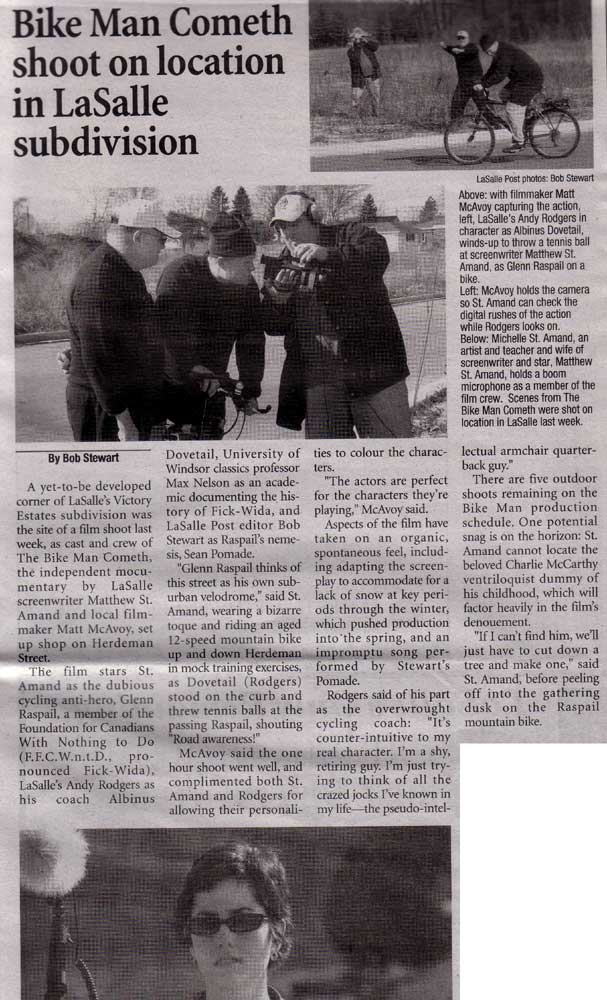
As the brainstorming sessions teetered toward the inevitable, I saw it was time to excuse myself from the group. I was happy for everyone who was satisfied by the progress, but I, for one, have gotten to the point where I cannot be a part of projects that are not credible. I'm not nine years old anymore trying to draw an animated cartoon with my friends using highlighters and crayons. So, I bowed out quietly.

However, the contrarian in me -- the inverterate burlesque-monger and satirist in me -- could not simply walk away from The Worst Idea Ever. As a writer, I've only ever worked with my own ideas and my curiosity was pricked by the morbid challenge of working on this idea that not only originated outside of myself, but yielded so little promise. So, I had a go at it drafting an initial 20 pages of script. But the inner kamikaze who sometimes guides my steps wasn't satisfied with my toying with The Worst Idea Ever. No, it prodded me to collaborate with a friend and once-fellow group member. This person wasn't a writer, but that didn't matter. All a person needs are ideas. But this person had only one idea about our inaugural collaborative session: he would lead the writing of the screenplay (with me as typist). There was much to admire about his drive and willingness to "step up to the plate," but there was unmissable, inherent folly in the idea, as well. Thirty seconds into hearing his ideas on how to conduct our collaboration I saw that he would unintentionally have us tread the selfsame minefields I had spent a decade and a half learning to avoid. Questioning the basis for his creative outlook only inflamed him. The situation was so obvious it almost defied analogy -- but here's one: you have two guys, one is an auto mechanic, the other knows nothing about cars. Who are you gonna trust to work on your car?

So, the collaboration was stillborn and so seemed my 20 pages of script in which emerged five characters: father, Gerhard Schwanghammer, who went by "Gerry," his wife Grace, their daughter Abigail, son Andy, and the deceased grandfather. Gerry worked a low-level job at a radio station, Grace was a piano teacher, Abigail a disaffected teenager, and Andy a quirky, annoying kid with a fetish for stand-up comedy, and deceased grandfather who popped up in the car with wry memories and observations about the volatile family.

After some back-and-forth email with the leader of the film group, I commenced to see where Grandpa, Gerhard, Grace, Abigail and Andy took me. I titled the script Mr. Brightside.

It took me six days to write the initial 86 pages. After meeting with the film group leader, who said everyone was excited by the excerpts I had sent to them. At the group's request, I took another few days and brought the page-count up to 112 pages. I submitted the script to the film group leader, received his "Thank you for the gift of this script" email, and was dropped from his consciousness like a facialized whore in a darkened alley.

Yes, I left the group. Yes, I didn't seek to be a part of the production. All my choices. But that script was the work of my hand. Yes, I would be credited as the writer, but somehow not consulted when the need for changes arose. Just from a common sense perspective wouldn't it be the best route having the person who created the script make the needed alterations? Especially when no one else in the group could even come up with a script of their own? Not in this case, it seemed, where the tinkering commenced almost immediately.

Nor did I have the wherewithal to countenance the farce that was the "audition" process. Oh, I heard all about the pantomime of a search for the right "Gerhard," but in the end the leader of the group (now director) deigned to cast the group member who (in my experience) displayed the least amount of concentration, seriousness, or commitment of the entire group in the lead, as Gerhard Schwanghammer. This person was, coincidentally, a friend of the director's.

The immediate problem with that choice was that the script was dialogue-heavy. The lead roles demanded actors with professional experience. Unfortunately, the only two professional actors in the film group were relegated to menial, off-camera duties (though one eventually shone in a bit part). In fact, when one of these professional actors did audition, the director amazingly ran out of film just before it and thus was unable to show that audition to the rest of the group. Didn't matter because the auditions consisted of "cold reads" anyhow, and the professional actor (as anyone would) was described as "not connecting with the character." Hearing of the catastrophic casting blunder -- giving the "class clown" the lead role -- I wrote the director expressing my frank misgivings about his choice. Accusations were made regarding on whose behalf I was actually voicing my opposition. But my point of view was simple: creative projects like making a feature length film are fraught with difficulties. Why unnecessarily hobble yourself before getting out of the gate?

But there was to be much more hobbling to come.

First, the group didn't understand the genre of the script they received. The script was a drama with flashes of humor throughout. The group misinterpreted this and believed the script was a comedy. That's like being at the wheel of a vehicle you believe is an automobile, when in fact it's an air plane. There are some fundamental differences at play that must be understood.

Then the changes came (changes are inevitable, of course; my complaint is with the hackneyed, ham-handed, arbitrary way in which these were made -- never with any consideration about what the changes did to the overall story).

Gerry goes by "Gerry" through most of the film, except when his wife, Grace, is angry with him, and snaps, "Gerhard!" It's not very funny insolated like this here. Read the script, you'll see how it adds texture to the characters. The director trashed this. No one in the group understood the use of the two names.

Tedious flashback scenes were added to the film involving the deceased grandfather. And characters were added. For instance in the middle of the movie, while at a hotel, daughter Abigail goes down the hall to the soda machine. There, she is accosted by a wan, failed Mormon. Someone in the film group raised the question, "Don't Mormons go around in pairs?" This may be true, I don't even know, but rather than accepting that possibly this failed, lone Mormon -- banished to missionary work in this lost burg -- is so hopeless as to be sent into the world with no partner, the director simply added another Mormon. This changes the dynamic of the scene entirely: You have a lone teenaged girl now confronted by two men at the end of this empty hallway. Humor turns into menace. A complete wrong turn.

Better yet was the addition of a transvestite to the diner scene in which the family is eating breakfast. Why not go for the cheapest, least substantial laughs imaginable? The director, in a fit of creative gusto and ecstacy, decided that the breakfast scene absolutely demanded a campy transvestite enter the restaurant to give the film that nanosecond of mirth as the entire place turn and look in surprise.

How do I know of these things, and more, having excused myself from the group before production commenced? I know. If the group met at the bottom of a missile silo, I'd know what was happening with my work.

Unfortunately for the production, the girl playing Abigail quit the project entirely. I feel for the cast and crew because this loss effectively destroys the second half of the film. I don't know as yet if any firm solution has been arrived at to deal with this, but one idea I heard was bandied about involved the daughter simply disappearing with none of her family particularly concerned where she had gone. At the end of the movie Grace, the mother, would receive a cell phone call, smile, and announce that daughter Abigail is safe and sound -- somewhere.

To be fair, this production is the film group's first effort. It would be entirely unfair to expect perfection or even a sturdy level of competence from them (anyone) at this point. No zing intended on that. Especially with filmmaking where there are so many tangible, technical aspects to be mastered. When attending the meetings, it was my opinion that the group wouldn't produce anything of competence or consequence until -- at least -- its fifth or sixth project. I know about the learning processes involved with creative work. There is no way to rush it; no easy way around it. And I do admire the group's willingness to forge ahead in the face of setbacks.

One thing never changes with regard to creative projects -- they are created one decision at a time with each decision's impact having a knock-on effect throughout the entire work. Edits, revisions, alterations are inevitable in any work, but they should never been made simply so someone can leave their own fingerprints on a work. Also, I firmly believe in running with peoples' strengths. If you have a professional writer at your disposal, trust him with matters relating to the script. You have some professional actors, use them onscreen. I'm making short films with friends at present and this is our strategy, and it's working out great.

Ultimately, my feeling about this is "shame on me." I brought this (whatever "this" is) on myself. I should have known no matter whom I delivered my script to it would be treated like a drunken cheerleader at a fraternity keg party. It's just one of those laws or rules that greases the wheels of the universe.

Monday, April 03, 2006

Lateral Life - If a Book Falls in the Forest Does Anyone Hear It?


I'm in the midst of watching again the documentary Stone Reader about Mark Moskowitz's quest to find author Dow Mossman who wrote the 1972 novel The Stones of Summer.

After reading a review in 1972 that declared The Stones of Summer the "novel of a generation", Moskowitz bought a copy, read some of it, and put it away unimpressed. Years later, however, he rediscovered the novel and came away thinking it was one of the best books he'd ever read. He then set out to read everything else Dow Mossman had written -- and found that Mossman hadn't published another book. In fact, it was as though Mossman had dropped off the face of the earth. So, Moskowitz set out to find him, which he documented in his film Stone Reader.

Watching this film again, it's got me thinking about what I get from books. I'm in a period right now in which I feel ravenous to read. I've never been a particularly fast reader, plodding through books, taking weeks to get through the slimmest novels. Then I have periods during which nothing satisfies. My personal library is invisibly pocked with countless half- or quarter-read novels. It's frustrating when I get into one of those inconsolable spins. At present, I'm at the other end of the pendulum swing, enjoying everything I pick up. Last Monday I read Ken Bruen's crime novel The Dramatist. On Wednesday I began Louise Welsh's Tamburlaine Must Die. On Friday I picked up Michel Faber's massive The Crimson Petal and the White, of which I had only read 240 pages a couple of years ago. I read as much over the weekend, and am now a little more than halfway through the near 900-page novel.

The simplest way to sum up what I get from book is the lateral lives they open to me. Bill Vitanyi's Kyuboria, Fred Exley's A Fan's Notes, Ken Bruen's Jack Taylor novels are all set in familiar territory: office life, bar rooms, urban Ireland. Yet they offer me insights my own seared and sucker-punched senses didn't pick up when I was in similar circumstances. Then there's the work of Tim O'Brien and his Vietnam stories opening a portal onto experience that has never been a part of my life. The final section of his book The Things They Carried is about the truest, most wrenching writing I've ever read, when he speaks about a little girl named Linda whom he knew in elementary school.

It's not so much that books and stories are opening doors on aspects of life I know nothing about, it's more like they educate me about what my own experience has meant to me.
I remember so vividly one day when I was six years of age standing in the school yard of Sacred Heart elementary school in Windsor, Ontario -- seven houses away from my own home -- watching a fight between two boys a couple of years old than me. One horrible aspect of watching this fight from a dozen yards away was seeing that no one around the scuffling kids paid them any notice.

At one point, one kid flipped the other onto the ground, where the subdued kid sat, stunned, dust rising around him. It seemed the fight was over with, and all of the anxiety that chaos and entropy and fear of physical violence caused me could tuck itself back away in my mind and await the next outward eruption of turmoil to latch onto. However, the fight was not finished. As the boy on the ground sat in stunned ignorance, the boy who had flipped him walked over to the edge of of the school building, which was only a couple of yards away. There he picked up a piece of jagged concrete that had been knocked loose from the school's foundation. The hunk of concrete was big enough to require its carrier to use two hands to lift it. And the kid who seemed to have won the fight turned from the school wall, lugging that large piece of concrete, approached his adversary from behind, and dropped it onto his head. Witnessing this, my nervous system went incadescent.

Until that moment, in the neverending loop of my own fears of schoolyard violence, I had always figured being kicked in the face to be the worst thing that could happen to someone in a fight. That piece of concrete fell square onto the head of the kid sitting on the ground, hyperextending his neck so that his chin struck his chest under the blow. As the hunk of concrete fell to the ground, the injured kid sprang to his feet and ran in a circle. It was clear he was moving with no more purpose or thought than a foul ball ricocheting off of a baseball bat. The injured kid then ran to the school and banged on a classroom window. It was recess or lunch time so there was probably no one in the classroom. Didn't matter. At that moment, the teacher who was on yard duty came by. All she saw was a kid slamming his fast against a classroom window. Rather than helping him -- she had no idea what had just transpired -- she, in fact, gave him shit. My stomach felt like a well into which any rock thrown would take an eternity to hit water.

That was my first experience with true life horror.
And it was that first taste of the outside world that was reintroduced to me by Ken Kesey's observations about "The Combine" in his novel One Flew Over the Cuckoo's Nest or what faced Jim in Huckleberry Finn or Tom Robinson in To Kill a Mockingbird.

If books and stories are portals onto lateral lives we have lived yet not lived, or have lived and need examined by other minds for us, what of novels like Dow Mossman's The Stones of Summer, which are "lost"? Or, those used-bookstore-gems like Tom McHale's body of work, particularly his first novel Principato? Can we only find ourselves in bestsellers? Of course not. For me, the lateral life has never been more lush and open than stumbling across a work wholly unknown to me until the moment I discover it on a used bookstore shelf. Like Christopher Nolan's Dam-Burst of Dreams, or Scott Smith's A Simple Plan, or Thomas Tyron's The Other, or Terry Griggs' Quickening, or Richard Grayson's Highly Irregular Stories, or Mark Twain's Letters from the Earth, or Larry Brown's Big Bad Love, and so many others.

Beyond lamenting my own obscurity, there is a writer I know and whose work I have read living in Iowa whose books and plays should be in every bookstore and on stages across North America. His name is Gary Britson. I interviewed him last year for an article titled Authora Non Grata: Interview with the best writer you've never read. I have read two of Britson's novels, half a dozen of his short stories, and a couple of his plays. He is an excellent writer whose wry sense of humor continually takes me by surprise the more of his stuff I read. But for some reason book publishers and theatrical producers deign to ignore his work. Our loss.

I have a copy of Dow Mossman's The Stones of Summer. I tried reading it the day I bought it two years ago, and didn't get far. The writing is exceptional, but dense and with little sense of story developing. I set it aside to read other books, but will get back to it. The documentary made about Mossman's rediscovery is a worthy testament to all "lost" novels that moved someone somewhere. It's wonderful hearing the filmmaker Mark Moskowitz speaking to people about the books that meant so much to him, and to hear of authors and titles I'd never read. All those lateral lives out there. All those clues strewn about bookstores, in attics and basements, in boxes gathering dust.

As a writer, it's heartening to imagine that something I might create may one day mean as much to some reader somewhere as Mossman's novel means to Moskowitz. At present my most frequent strangers speaking my name are bill collectors. Manuscripts are piled in my office and in my basement like mute, outsized doorstops. Beyond my desk, I'm unemployed Matthew St. Amand, deficient Matthew St. Amand, always-looking-for-a-job Matthew St. Amand. But as a reader and a writer, I flourish in my lateral lives where my victories suffer under paradoxes similar to Flann O'Brien's mystic elevator in his novel The Third Policeman that descends into heaven/hell -- I can take nothing back to my own life except myself.